Wednesday, March 27, 2013

Caroline LaBrie, Canadian Jouster.


Several years ago I had the pleasure of meeting Caroline LaBrie. She is one of many Women Jousters that I wished to interview. As sometimes happens, we lost contact with each other, and then remarkably thanks to Facebook, were able to once again make a connection. I have not as of this writing profiled a woman who jousted.-Not for a lack of knowledge of Women Jousters, just the time and the person hadn't yet arrived.

Well that person and that moment have arrived. As you will see in the photographs with this article, Caroline LaBrie is always smiling. Every once in a while we come across a person, who has a genuine sense of Joie de Vivre.-An exultation of spirit, a happiness to be alive. For me it is a real pleasure to introduce her here in my blog. She is also a shinning example of what I call the Modern Medievalist scene that is rapidly gaining 
prominence in Canada. As another put it to me, "Canada doesn't have a medieval tradition, like Europe. But we have a very strong set of European medieval ancestors.-So the traditions, seem to come readily to hand."At any rate, I think Caroline's words and her photographs should tell their own story...enjoy!

(c) Claude Charbonneau

Q: When did you decide you wanted to Joust?

A: In 2000- when I join a group of medievalist who were performing in a show

much like medieval times. I was recruited as a squire then and started slowly working my way up!

(c) Catherine Morin-Michaud

Q: How long have you been riding?

A: I've loved horses for as long as I can remember, I was riding as a child / adolescent in location center but I began to learn more seriously in 2000 when joining the troupe.


(c) Pascal Ratthe

Q:When did you start actually Jousting?

A:In 2005, when my horse was fully trained and ready…so as myself!


Q: Who made your very unique looking armour?

A: Benoit Desjardins from l’Armurerie du Dragon. He was referring on a drawing made by Steve R Gagnon, artistic director and International jouster.


Caroline breaking lances with Damien Martel.
@ The Joust Médiévale internationales de Lachute 
September 2012.

Q: What has been the most surprising thing you have discovered since you began?

A: The bond between men and horses. Gaining their trust, their respect, it is a beautiful partnership and this will always be an amazing thing for me, a gift.


Caroline with her best Equine Friend and Partner for six years "Nemrod."
(c) Jean Francois-Rivard.


Q: What has been the hardest thing for you to learn how to do?

A: I am left handed, when I started doing the games and eventually, the joust, I always had to train a bit more than my partners to gain accuracy. Another challenge is changing from a medieval gown to an armor in ten minutes after a carousel! 


Q: What do you like the most about Jousting/Fighting?


A: The opportunity to experience a few glimpses of what it was like for knights and warrior in the medieval ages. Being able to learn from it and share that great experience with the public. There is also that part about making a dream come true, an inspiration to youngsters to believe in themselves and work hard to achieve their goals.


Caroline at full throttle!

Q: Where do you expect to be in five years from now?

A: I have been lucky enough to joust the past three years with my friends horses since my former horse had to retire in 2009. I’m working with a stallion I intend to buy in a near future and train more seriously in dressage. Working with horses is a gift and I want to keep on learning and bringing up my personal goals in this sport that I love.


Q: Have you found acceptance or have there been resistance to you being a jouster?


A: I was lucky enough to start my evolution in a show where the winning knight was a girl! Even if I never made it to that role before we finished presenting this show, the group was always very supportive.


Q: Is there anything you have yet to do in a medieval context that you really want to???


A:I have a new horse to train, a pure breed Canadian stallion. I hope he will enjoy tournaments and reenactment. As I was saying earlier, I would love for him to learn some Haute-École moves and being able to do some dressage display during the events, combined with the joust.


PS Bonus Question: What do you do to support your horseback and Jousting... What sort of job?


A: I work as an administrative assistant. On the clipboard next to my desk are some pictures of my son, horses and great shots from tournaments to keep on remembering how lucky I am to be able to live the dream!

Because she Jousts, never for a minute think she is not a lady.-DS Baker

I would like to think Caroline, for her time, her effort in speaking with me, and making herself and her world available to me. She is a private person and for her willingness to participate in this interview it was a wonderful and delightful gift.-Merci Beaucoup.

For those who would like to see Caroline LaBrie in the lists, I have a You Tube video link for your enjoyment.
This is the Joust-Médiévale internationales de Lachute Held in September of 2012.

http://www.youtube.com/watch?v=9Lqs_CKibiM


All my absolute best!

If you have enjoyed the interview please leave a comment in the space below!

DS Baker. 


Sunday, March 24, 2013

Armour Smith-Jiri' Klepac of the Czech Republic!


(c) J Klepac

This is the first in what I hope will be a series of interview about Armour Smith's and their amazing products.I choose Mr Jiri. Klepac, because I have known of his work for the better part of a decade. Also like most great smiths, he feels that, "Form Follows Function."-Meaning there was a very good reason why European Armour had the look that it did. To answer the unasked statement, hanging in the air,-Yes European Armour was heavily influenced by clothing fashion, but... it had to remain functional. To that end I have chosen Mr. Klepac's work to be the first Armour Smith portrayed. His work, once finished, has a museum quality look to it. With all that being said, I think Mr. Jiri Klepac's own words and his amazing art should speak for themselves.

Maximilian inspired helm, similar to one owned by Otto Heinrich
Etched Close Helm 
(c) J Klepac


Detail of Maximilian style-Otto Heinrich Inspired Helm.

(c) J Klepac

What follows below is my interview. I hope you enjoy reading it, as I did in asking the questions.


Q: When did you decided to make armour.-Meaning what made you want to make or craft medieval and renaissance era armour?

A: I started at the age of 15. My motivation was originally only to have the armour for my reenactment activity ,that I could not afford buying. Quite soon I realized that forming steel is fun on its own.

Q: Did you go to a school of art and design?

A: Not at all. I studied economics. I read a lot of books on the topic, I like watching the art and design pieces of various styles, this is my only education in this field. Making reproductions is much easier when it comes to design invention than making new pieces IMHO.


Hot Raising a XIV Bascinet.
The Shaping Process

The finished Helm
(c) J Klepac


Q:  Did you ever apprentice yourself to another Smith.

A: No, I have seen many armorers working on their videos and many smiths working. Vast majority of all I know is from the books, fabrication marks on original pieces and trial and error school. I can say that Eric Thing influenced me a lot, showing the gas forge and the basic guide for making helmets in one piece in his article. This text finally made me to start one.

Q:  Where specifically do you get your patterns and armour styles from?

A: I am trying to influence the original style of armour by my own creativity as little as possible. I prefer understanding why they did the piece, in the manner they did, rather than going my way from the perspective of a modern armour smith. I build 95 percent of my patterns myself. Patterning is quite easy for me now, after more that 15 years of experience.


Beginning the Hot Raising Process.
(c) J Klepac
The Shaping process.
(c) J Klepac
(c) J Klepac
The finished Grand Bascinet
(c) J Klepac


Q:  How much time is spent in researching each article of armour you create?

A: Depending on the project. On full armour without perfect documentation, it may be more than 50 hours. I start at the moment, what I think I understand the design and have the production process fully set in my head.

Q: Where did you learn metallurgy?

A: Mostly from machinist´s and blacksmiths´ books, also from my friend who does heat treating for living and was keen to try various methods of heat treating on steel for armouring. Last but not least from the priceless book by Alan Williams: The Knight and the Blast Furnace. I still keep learning, there is so much to know.

Q: How close in the types of metal and in the design do you try to adhere to, when creating say a piece from XIV Century?

A: I try to stick on the original design as much as possible, being affected only by client´ s taste and size and level of my ability to reproduce the piece properly. I use C45 steel (AISI 1045) for most of the projects. I plan to give a try to wrought steel one day. This is a challenge!


XIV Century Globose Breastplate based on the famous
Churburg Castle Harness.
(c) J Klepac

XIV Century Tulip Gauntlets
Also inspired by the Churburg Castle Armour.
(c) J Klepac

Q: Has any of your work appeared in or for museums?


A: Several of my pieces are in the exposition at Kuneticka Hora castle in the Czech Republic, one helmet in museum of Usti nad Labem. Several pieces are also in private museum in Italy. Most of the time I work for private clients.

Q: Of the different styles of European Armour you have created, which era or style has been your favorite to create?

A: I love Milanese 15th century pieces. Second most favorite is German style of middle of the 16th century. I like plain field pieces most.-The real fighting stuff.

XVI Century German Inspired Black and White Harness
(c) J Klepac

XVI Century German inspired Black and White Close Helm
(c) J Klepac

XVI Century German inspired Black and White Gauntlet
(c) J Klepac


Q: What has been the single hardest and at the same time, the most rewarding piece or harness you have created thus far. Or another way of saying it might be, What was your master's piece. The one piece of armour that took you from a talented enthusiast to that of a master smith?

A: I guess, It was a grand Bascinet I made some 5 years ago. It was a big project for me. This project required raising of a really big and deep bowl and a lot of research and engineering to fit pieces together at the same time. There is still so much to learn, which gives me the motivation for the next commission.

Here are some more examples of his work:

Front View XVI Century Spanish/Italian Cabasset Helm
(c) J Klepac

Side View XVI Century Spanish/Italian Cabasset.
(c) J Klepac


For those interested, Jiri Klepac has opened his commissioning que for the month of March 2014. It normally takes a year to reserve a spot in his production schedule...

Jiri Klepac's website can be found at:
http://www.armour.cz/

His e-maill address is:
jiri@armour.cz

He also has a short video on YouTube demonstrating  hot raising a Gothic Helm:

http://www.youtube.com/watch?v=4s-Lnu1ukr4 -It should be noted the video is in Czech.

Thank you for reading. Please leave a comment in the space below the article


All my absolute best!

DS Baker.


Thursday, March 7, 2013

International Jouster Marc Hamel of Canada!

Recently Modern Medievalist, had an opportunity to visit with Marcus Hamel, world famous Canadian Jouster. Here is our interview. Merci beaucoup mon ami.

Tournoi du Lys d'Argent-2011


Q: Marc-When did you become involved in what I like to call the Modern Medieval world?

A: It began in 1994 after we had our first introduction in a medieval event in the capital at an event called "Les Medievales de Quebec" which happened in 1993.

Q:Where did you first begin to Ride/Fight/Joust?

A: Started to learn to fight in 1994 with a Viking group, then in 1995, created my own group "Circle of the Pendragon" with more knightly virtues, than another group created in 1997 "The Brotherhood of Ironmen" Introducing full contact fighters. During that same period I put in more serious horse riding in the hope of one day, I would eventually joust. In 2001, I joined a group of actors who, were doing a jousting show like "Medieval Time," Where I have been able to put more progress in my skills and my horse riding as an introduction to jousting.

Q: Has the Canadian "scene" started to catch on ... Medieval Jousting Events as opposed to Ren-Faires, Gained in popularity?

A: Our country never lived the medieval period, nevertheless people from the French province (Quebec) have this passion for history and their origins. When they saw the first medieval event (1993) They went nuts for it. The Quebec city made ​​another one in 1995 (I Participated in it) and it was great, but MOST of the people wanted something more of Their historical past, so in 1997 the city has made ​​a renaissance fair and it's been very popular ever since.

Jousting in Italy-2010


Q: I know that you served in the Canadian Military. Has your training, helped you to prepare for the rigors of Jousting?

A: My military service (7 years) was in the Infantry. So it did greatly help with the discipline and the focus to reach my objective. I made two overseas tours in my service; 1992 Cambodia and Croatia from 1993 to 1994 and I end up with a PTSD. When I was released in 1996 I was broken, depressed, and very angry, and I couldn't find the peace in my soul. My uniform became my armour. Many years of fighting finally brought me to jousting ..... it's been a long process to heal my wounds, I can assure you that I have never felt so alive, as  when I joust and it makes me very appreciative of the moments I have had, and the people whom I have met.

Mike Loades conferring Marc Hamel before entering the Pollaxe Combat
The Phoenix Joust-2012
(c) Leslie Chappell-Britt.


Q: How many countries have you visited since you began jousting.

A: As a jouster I have traveled to Belgium, France, Italy, England and the USA. This year I'm going to Poland, France and England again.

Q: Who made your armour?

A: I have built my own armour 6 times. I've never been rich, but I am very passionate about jousting. So I built my first one in 1996, till the last one in 2011. Now that I have better means, I am clustering this year four armourers: Francios Le'Archeveque, Serge Lavigueur, Eric Dube and Jeffrey Hedgecock. These people are very good friends, who are much more talented than I am For my latest armor, I wanted to have pieces for sentimental value as well as pieces that are historically accurate.

Q: Did or does your horse like to Joust?-For those that might not know this is an activity that a horse might not want to do...

A: As you said, it's not easy to bring a horse to like jousting. I think it's a long process that doesn't need to be rushed. Some horses will never tolerate  armour no matter how long you train them. From my point of view ( I don't have the ultimate truth) you need a horse without fear, then you need to built a solid trust, then you can think about bringing your armor along. My new horse (Canadian/Quarter Horse) is in the beginning of his training put he's has a lot of potential, I'm not rushing things so his progress is very promising.

Q: What is the single hardest skill you have had to master.

A: Keeping cool or frosty, in the heat of the moment.

Medic attending Marc
Tournament of the Phoenix Joust-2012
(c) Amanda Mielke-Camera Wench Photography.


Q: Where do you expect to be in your sport in five years?

A: Hopefully in five years, I want to be able to teach others how to joust.

Q: Where did you learn how to fight with a sword?

A: I took lessons from sword master Jonathan Verville, he is the trainer for the Battle of the Nations Quebec team, and he learned from a French sword master Franck Cinnato. When I went to Belgium for my first ground combat tournament, I realized that we were using the same treaty/style as the Europeans did in their basic sword/foot combat.

Q: We heard you have had some success of lately, tell us how the international jousting scene has been treating you?

A: As I like to say, I've been a lucky bastard  . But more seriously I am a very respectful person especially of other's who have created the events I joust in, and when I joust I do the best I can to be safe for the horse. I try to ride as well as my opponent and his horse.. I help whenever I can when I'm on the ground just like any other squire or ground crew to make an event successful. So I guess with that kind of attitude, I receive nothing but great respect from the international jousting community. To me jousting and ground fighting are really cool means to meet great people with their passions and history.

Jousting in Italy with Fred Piraux of Liege, Belgium
2010.


I want to thank Marc Hamel for his time. Marc's first language is French, then English. So I appreciate his taking the time to translate his replies.

Here are some video links from Hamel's jousting and foot combat.

Marc Hamel crossing lances with Dr. Tobias Capwell, Tournament of the Phoenix Joust-2012.
http://www.youtube.com/watch?v=wy3h1Pr3BXY

Marc Hamel and Luc Petillot Fighting with Pollaxes, Tournament of the Phoenix Joust-2012.

http://www.youtube.com/watch?v=jZqQQ3PhD14


Monday, March 4, 2013

Coming to this blog soon...!

I have several new posts in the works! I know the site has lain fallow for several months. I won't bore you with the details but, suffice to say I will be bringing several new posts to the site in the coming week or so. I have two interviews with Internationally Ranked Jousters to complete and a possible story on the Genetics of Medieval Horse Breeds to work up.-Which might help inform and or dispel any misinformation of certain types of horses.

Also-I have a new co-editor for my Facebook Community Page. His name is Russell Jensen. We have relaunched our Facebook page, and it seems to be a big hit! Thank you very much for your support, and those critical messages of "Keep Going!"

One last favor I would ask. If you come the Facebook page, and you see something you like, please leave a comment. Every comment left, makes it easier for you to find us in your search engines. Also please don't hesitate to tell us, what you want to see. We can't be every where and, Russ and I both have our time periods that we favor. So, let us know and we will do our level best to post something you might want to read!

This by the way... is our Avatar on Facebook.

All my absolute best!

David

Friday, November 30, 2012

Colonial French Louisiana Christmas Traditions!


BONFIRES ON THE LEVEE

BY EMILY CHENET GUIDRY

FOREWARD

Many pages would be required to relate the stories concerning Christmas Eve levee bonfires in St. James Parish, Louisiana. This is merely an attempt to bring to the reader some history of the custom which has experienced a phenomenal growth in recent decades.

Once few in number, the local bonfires were originally a neighborhood or family -oriented activity. Now they line the levee for miles and attract thousands of visitors. Neighboring Ascension and St. John Parishes have a scattering of Christmas Eve bonfires, but by far, the greatest concentration is in the St. James Parish Communities of Lutcher, Gramercy and Paulina.

The event has had local and national television coverage and has been featured in metropolitan newspapers and magazines. The pre-Christmas open house of the Gramercy Volunteer Fire Department and the Lutcher Festival of Bonfires draw many people to the area in the weeks preceding Christmas Eve.

Through the years, there has been an intermingling of facts and fantasies concerning the origin of the bonfire tradition. In an effort to determine the history and development of this unique practice, a part of our research has included personal interviews with some of the oldest living residents of the area. A few of their recollections are included here.

*The following article was gleefully stolen from the St. James Parish website. I hope that they will not sue me. To visit their site, which is just full of the wonderful historical tapestry that makes up St. James Parish, please visit their web site at: www.stjamesparish.com/

All credit for this article is due to their hard work, and dedication.


BONFIRES


Webster's Dictionary defines a bonfire as "a large fire built in the open air", a word derived from the Middle English bonefire- a fire of bones. More to our purpose, other sources define a bonfire as "a festive fire" or a "contribution fire", that is, a fire to which everyone in the neighborhood contributes a certain portion of material.

There is little doubt that the local bonfires along the River Road meet the definition of a "contribution fire". In the weeks following Thanksgiving, the levee is alive with activity as scores of young people work together, contributing labor and material to create the masterpieces that will be ignited on Christmas Eve.

Weather permitting, fire chiefs give the signal at 7 o'clock, and the St. James Parish residents simultaneously set a torch to their bonfires, re-enacting a fire ritual long-performed by their early European ancestors.

BONFIRES IN EUROPE

In observations made centuries apart, several European writers concluded that bonfires still constructed in certain parts of Europe are the outgrowth of an ancient Celtic custom of building large ceremonial fires to honor the sun.

Centuries before the birth of Christ, the British Isles and Gaul (France) were inhabited by the Celts whose powerful religious leaders, the Druids, had the sun as their principal object of worship. To pay homage to this great source of power and light, fires were built at the time of the winter and summer solstices. The Celts were dependent on farming for their tribal livelihood and believed that the fires would hasten the return of Spring and prolong the days of Summer.

Following the birth of Christ, Druid beliefs were gradually supplanted by Christianity, and the fire rituals took on religious meanings.

The ancient summer solstice celebration spread throughout many nations, and was moved to June 23rd, the vigil or eve of the anniversary of St. John the Baptist, who, according to the legend, represented a "lantern of light" to the people. The festive fires were burned in his honor.

The winter solstice fires, fewer in number, became the Christmas Eve bonfires still burned in certain parts of France. The Christmas Yule of, known in France as "La Buche de Noel", is also believed to be a remnant of the ancient winter solstice fires.

The summer fires of St. John the Baptist were by far the most spectacular and joyful of the festival fires. Wars, plagues and the passage of time did not stop the people from building their Fires of Joy. The custom endures to this day, especially in France where the summer fires are known as "Le Feu de la St.-Jean D'Ete", and in Germany, from the Rhine River through Bavaria.

In June 1988, just prior to the Feast of St. John the Baptist, members of a local historical and genealogical group visited the region of Alsace, the homeland of many of their ancestors. Throughout the French countryside they saw countless bonfires, which, although richer in symbolism, were almost identical in size and regular pyramidal construction to St. James Parish's own traditional Christmas Eve levee bonfires.

On the German side of the Rhine, similar summer bonfires (sonnenwende) are constructed on hill tops and the bonfire lighting is accompanied by the rolling of a wheel down the hillside. In earlier times, the wheel was wrapped in twisted straw, ignited, and rolled down the hill, signifying that the sun, then at the highest place in the sky, was beginning to descend.

BONFIRES IN ST. JAMES PARISH

The area of Louisiana now known as the River Parishes (St. James, St. John and St. Charles) was settled in the early 1700's by the Old World French and Germans. These early colonists brought with them the knowledge of both summer and winter bonfire customs and traditions which they had known in their native lands. By sharing this knowledge with their many descendants, they provided the inspiration for a practice which has evolved into one giant celebration - the present-day Christmas Eve levee bonfires!

Of necessity, survival and the establishment of a new colony were the principal concerns of the French and Germans who first settled along the lower Mississippi River. These early colonists undoubtedly built a few celebration fires, but early history of the area has failed to record any information about this. As a result, as the bonfire custom increased in recent generations, so has speculation about the origin and development of the tradition.

For example, one of the more recent and increasingly popular explanations is that the bonfires were a "Cajun tradition", first used to light the way for "Papa Noel", the Cajun version of Santa Claus. This charming version, although improbable, has been depicted annually in front of a Paulina, LA business establishment where a levee scene shows "Papa Noel" with his pirogue drawn by alligators named Gaston, Ninette, "Te-Boy", Celeste, Suzette, etc.

Some Acadian exiles from Nova Scotia settled in St. James Parish as early as 1765, with many more arriving in the 1780's, but "Papa Noel" was not yet known to them. It was on New Year's Eve that the little French children received their gifts.

In South Louisiana of old, Christmas was a strictly religious observance, and it was New Year's Eve that was marked by the exchange of gifts and the "reveillon" to see the old year out and to greet the New Year. In Cabonocey: The History, Customs and Folklore of St. James Parish, published in 1957, the author, Lillian Bourgeois, tells of this custom of celebrating New Year's Eve with a gathering of family and friends who enjoyed a gumbo supper, eggnog and the burning of huge cone-shaped bonfires on the batture, the land area between the base of the levee and the water's edge. With the passage of time, these activities gradually moved to Christmas Eve.

Some have also offered the theory that the bonfires served as navigational signals to guide ships along the river, or were used to light the way for the faithful to attend Midnight Mass.

Through 1865 letters still in existence, it has been established that the summer feast of St. John the Baptist was then celebrated in neighboring St. John Parish (known as the Second German Coast) with the lighting of fires and the homecoming of relatives that lived away.

A recently discovered 1871 picture shows members of the Lacoul and de Lobel Mahy families gathered around two bonfires built on the levee in front of Laura Plantation in West St. James Parish. The men pictured are wearing coats and the women hats, but the time of the year is not specified.

In 1989, I participated in a local study on the development of Christmas Eve bonfires in the River Parishes. Many older residents or their descendants were interviewed to learn their knowledge of the history and traditions of the custom.

In a personal interview with H. D'Aquin Bourgeois, son of George Bourgeois, a St. James Parish native-born in 1855, I learned that the elder Mr. Bourgeois, an enterprising merchant, had built Christmas Eve levee bonfires in from of his New Camelia Plantation store as early as 1884. Throughout the year, he collected wooden shipping crates, some as large as 3' x 5', in which merchandise for his store had been shipped. These crates, along with old lumber, were used to construct a Christmas Eve bonfire for the pleasure of local residents and the children of his store patrons. The blazing bonfire, the sound of exploding fireworks provided by the store owner, and the gleeful sounds of the children attracted riverboat crews who interrupted their travel to join in the celebration. Bonfires at this location continued until1930, and in later years grandchildren and great grandchildren of the original builder resumed bonfire construction at the same site.

Another 1989 interview with Mrs. Hilda Gabb Cambre, a St. James native born in 1901, revealed that she had known Christmas Eve yard bonfires during childhood days spent on her grandfather's Magnolia Plantation in West S. James Parish. The bonfires, built with any type of wood available, were part of a festive occasion where lanterns were placed in the trees and eggnog was served to the guests. In later Christmas seasons, kerosene-soaked cotton balls were lit and rolled down the levee. (Could this be a counterpart of the German wheel-rolling down the hillside?).

The use of kerosene-soaked cotton balls was also related by Mrs. Cecile Dornier Jacob, and East St. James Parish resident who shared bonfire stories told by her grandmother, Mrs. Florian Dicharry, born in 1851. These Christmas Eve bonfires, built in the pasture near the family home, were in later years topped by a flag to signify completion of the structure. In a Christmas Eve game, the young boys formed teams trying to hit the flag with kerosene-soaked cotton balls wrapped around a wire frame.

Yet another St. James native, Mrs. L. Boneno, born in 1893, told her family that as a child she stood on the levee of the West Bank of the river and watched as the burning of a levee bonfire illuminated the sky on the opposite side of the river. It was her opinion that the large bonfires, although few in number, were built by the more affluent families, probably those of plantation owners.

While these sample interviews establish the existence of levee bonfires well before the turn of the century, an equal number of people of the same age group had no knowledge of Christmas Eve bonfires in this area.

The difference in recalling the event is understandable when we consider that the rural families lived far apart, had transportation limited to the horse and buggy, rarely left home at night, and had no newspaper coverage of the event!

In increasing numbers, people born in the decade of World War I, in the 1920's and 1930's, recalled small yard Christmas fires and told of the gradual resurgence of the larger levee bonfires. Vividly recalled by some were the levee bonfires built by the families of Welham Plantation, first in the pasture and later at the base of the levee. Initially, the Welham fires consisted solely of an anchored center pole, surrounded by recently cut sugar cane reeds held in place by an encircling wire. Later generations of the family added scrap wood and rubber tires and moved the location to the base of the levee.

During World War II, bonfire building ceased, but was resumed with increased enthusiasm in the post-war years. Slowly, the structures became more standardized in size, shape, and materials used. Willow, growing in profusion along the riverbank, became the wood of choice.

Equipped with axes, hatchets and hand saws, boys of the "bonfire clubs" cut trees, stripped them of their branches and hauled them, one by one, to the chosen levee-top site. The bonfire's center pole was selected, placed upright and secured in a hole several feet in depth. Depending on the shape intended, the center pole was supported by four or more center poles, interspersed with logs cut to a desired size. Discarded rubber tires, collected throughout the year, encircled the center pole, or were used along with other combustible materials in the bonfire's center. When burning, the tires created a thick, dark smoke and multi colored flames. A few days before the scheduled bonfire burning, the boys walked miles to secure freshly cut cane reeds to place within and around the structure. While burning, the cane reeds emitted a popping, fire cracker-like sound.

In the mid 1950's, a residential subdivision developed along the River Road between the towns of Lutcher and Gramercy. With more young families living near the levee, the bonfire building custom exploded!

Chain saws replaced axes, hatchets and handsaws. Logs and cane reeds were transported to the levee top by pick-up trucks rather than muscle power and determination. The structures retained the traditional teepee shape, but with precisely cut logs became artistic masterpieces. Non -traditional bonfires gradually emerged in the shape of plantation houses, riverboats, etc.-structures of such beauty that it seemed a shame to burn them.

With increased press coverage of the levee bonfires, the once quiet River Road soon became the site of a giant party. Thousands of on-lookers arrived in private automobiles, motor home, riverboats and tour buses to join local revelers in the Christmas Eve celebration.

As the number of bonfires and spectators grew, more stringent regulations about materials and construction grew necessary. Environmental concerns about pollution resulted in a ban on the burning of rubber tires or toxic materials. The swamp replaced the Mississippi River bank as the source of willow logs. Safety concerns created construction size and spacing limitations, which were spelled out in building permits.

Little did the early French and German settlers of this area dream that the bonfire legacy left to their descendants would one day make Christmas Eve a VERY special time in the River Parishes of Louisiana. Had they known, they would have nodded in approval as they said "Joyeux Noel" and "Frohliche Weihnacten"--MERRY CHRISTMAS!

Preview of things to come! Christmas is coming!

This is a short note to my readers. I am preparing with the help of many friends, to bring some of the traditions of Christmas from across the land. The areas I want to show are from the Czech Republic, Croatia, England, France, Germany, Austria, Poland, Serbia and anywhere else I can dig up.

So you my valued, and dear readers, if you have a tradition to the coming holiday season, please feel free to leave a comment directing me to where I can find it on the internet. I'll be happy to post it. Happy Holidays!


Saturday, November 17, 2012

Company of the Golden Keg-Serbia's 14th Century Reenactment Group!


Here at the Modern Medievalist Blog, we oftentimes have the luxury of reporting on the efforts of individuals, and groups who are absolutely top notch in their fields of endeavors. What doesn't get stated, or is just assumed is, most of the people reported here, come from countries that have cherished their traditions and have established museums and institutions which preserve their history.

In America we have thousands of museums and institutions that are dedicated to the preservation of knowledge, and history. Albeit from a somewhat Western Euro centric standpoint. We also have Native American Indians or Indigenous people who have histories, and cultures that go back to the stone age. For the American Indians, one of the biggest trials that they have had to face, has been the preservation of their history and culture. Most have succeeded to do so in one form or another.

What if you are from Europe, or more specifically Eastern Europe? People as a rule assume, rightly or wrongly that everyone in Europe knows their history, and as far as their culture goes… they are living everyday in their culture …right?

The Pannonian Basin or Balkans as it is most commonly referred to as, is one of the most fought over and historically dynamic regions of the world. Greeks, Romans, Visigoths, Franks, Byzantines, Russians, Poles, Croats, Serbians, Bulgarians, Turks, Magyars, Germans, Italians, and Austrians have all at one time had either overt influence and open warfare in the region or have been covertly influencing cold war politics since, humans stepped foot in the region.

I will not go into the last 90 years of politics of the Balkans. What I will say is that for those who want to know, need to know their culture, their history, their triumphs and their losses, the Balkans in particular offer a dizzyingly difficult challenge.

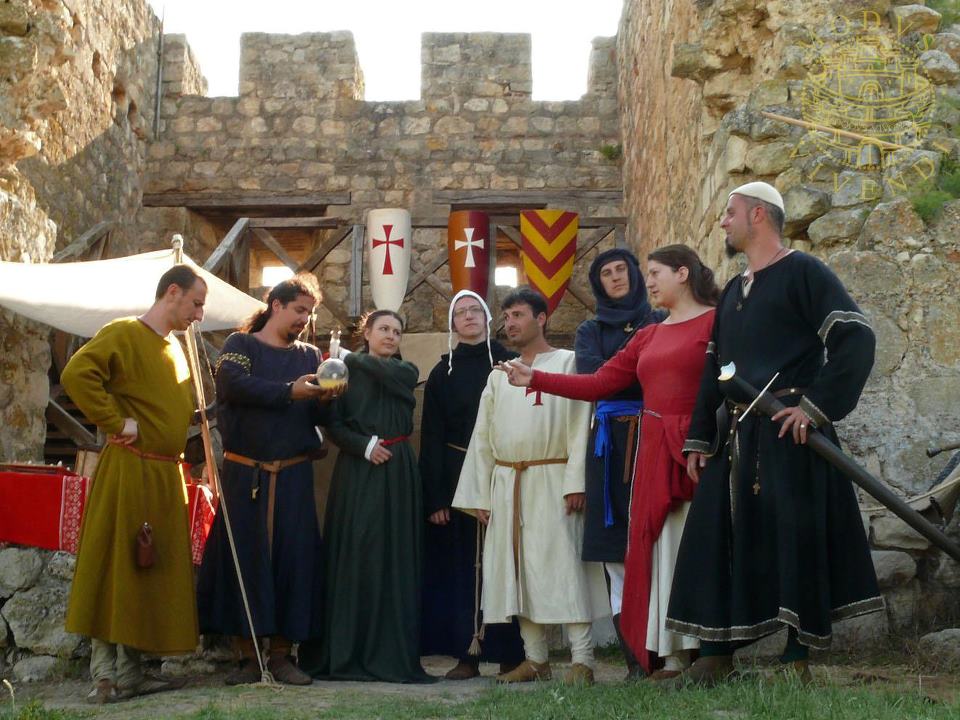
So it is rare to see the beginning of something. Rare to witness a group of dedicated individuals starting something from almost nothing. It has been my greatest pleasure to have been introduced to “The Company of the Golden Keg.” They are a 14th Century Reenactment group from Serbia.

They are all universally young. With their youth, comes a passion to know, and understand their culture at a bone deep certainty. From my observations, and interactions with them, they struggle mightily against, years of cultural neglect, propaganda based on a desire to create a sense of nationalism that has little basis in fact, outside perceptions of what it means to be Serbian, cultural, and religious conflict.

-All in an effort to know the facts of their history, to accurately portray who they are, and where they come from. I think they are doing an amazing job at it, and deserve a great deal of attention. I am also proud to call them my friends. Besides there is a certain cachet, a sense of craziness that I find so very attractive about a group who names themselves after a pub!

Srdjan Obradovic


Q: Tell us about deciding to create 14th Century Reenactment Company in Serbia?

A: We all long knew each other from forums on the internet, and we all shared a passion for history of medieval Serbia, and especially the 14th century, so after some time we decided it is a good idea to form a reenactment group. We named it after the pub where we hang out –“The Golden Keg.”

Q: Why did you choose the 14th Century?

A: -Serbia was in turbulent times back then, while going through a whole range of socio-economic transformations, and an emerging new social class of wealthy commoners. Again, the "ease" and "low cost" of procuring 14th century armour compared to mid 15th century was a minor point.


Q: At what level of reenactment do you wish to attain? Would it be something similar to Projekt 14?

A: We try to do our best in accordance with our current situation. Which is not that easy, when you know that right now, reenactment in Serbia is still at its beginning. We lack craftsmen, reenactors, equipment, you name it…
Being reenactors in Serbia means that you should be a factotum, and learn the trades of armouring, leather craft, sewing, chainmail weaving, woodworking, blacksmithing, etc. It is easier nowadays, different guys managed to specialize  for certain crafts. We also managed to build a kind of information network…  long story short, we really aim for a high level of reenactment. But current situation don’t allow us to go as high as we want. When you start from scratch you are usually not able to devote as much attention as you would like to certain details.

Q: Would like to eventually participate or even host an international event similar to the ones Projekt 14 does?

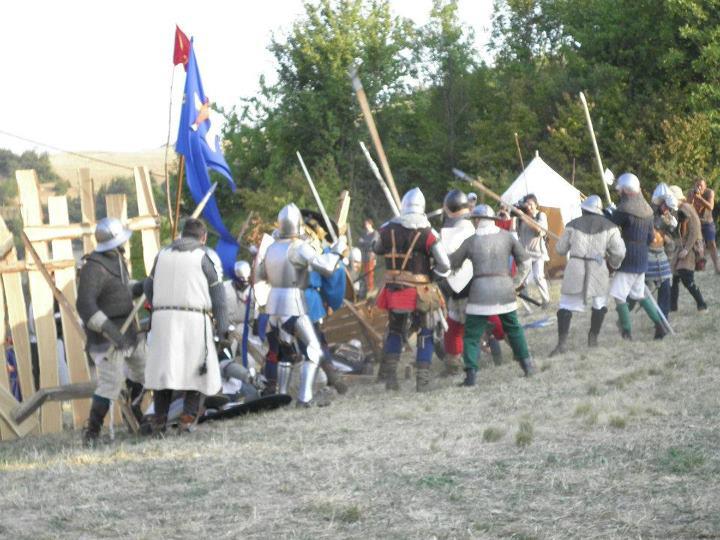
A: Well yes… Since there are not many Living History events in Serbia, we have to participate in those abroad. Last year we broke the ice with events in Ukraine and Bulgaria. For next year we have invitations for several more events that are outside of Serbia. About events in Serbia – there are none that are purely Living History events. There is one held at an old medieval fortress Koznik, near Aleksandrovac, organized by a local museum.

Castle Koznik and Fighting in the Pass

Q: What was the significance of the event you held at Castle Koznik?

A: It was the first truly multi group medieval event in Serbia. And, as far as we know, it was the biggest event of that kind in this part of Europe. It took close to four years of planning by a local Heritage Museum in Aleksandrovac. They provided all the money for the organization, the actual event, and trip expenses for participants. We had groups from Czech, Bulgaria, Ukraine, and Serbia. They were all impressed by the hospitality and friendly atmosphere. Also, it is important to say that there is a huge amount of support for this event from the local community. Everybody who would like to come is invited, and most importantly welcomed.

Doba Karlova of the Czech Republic
Modvs Vivendi of Bulgaria
Chivalric Order of Paladins, Ukraine

These are some of the groups who participated at the event held at
Koznik Castle.

Q: What is your greatest strength?


A: Our greatest strength is knowledge and diversity of crafts we all know. We are not experts at them, but we tend to improve ourselves over time. We are all mostly college educated, one of our members is an archaeologist and one is a historian. We put a lot of effort and time in studying of original sources. Our harness is still not the way we
want it to be, but we are constantly working to improve it. There is also a tremendous amount of love, and certain level of insanity - ingredients that you need to have if you want to be a reenactor.

Q: What is your biggest flaw as you see it

A: Sluggishness, which is probably consequence of most members living in different towns.

Q: How many reenactment groups-regardless of time period are there in Serbia?

A: There are three declared reenactment groups in Serbia, but some of them interpret history rather freely. We expect two more to come, but we will see. We do wish the scene to grow with more good groups.

Q: How closely aligned to Serbian History do you wish to become?-Meaning do you eventually want the group to be a Living History Group, that teaches and informs Serbians about their history, by working with a University or Archaeology Institute?

A: Our group’s main purpose is to raise awareness about our medieval heritage. After all, that past is who we are. Those were our ancestors. As for concrete cooperation with institutions, we have had good experiences cooperating with some museums and would not turn down an opportunity to help academia when possible (and get as much knowledge in return.)


Camp Life In The Company of The Golden Keg.
Ukrainian shield after a hard day of fighting..

It should be noted that, although it sounds like one voice replying to my questions, all the members of the group participated, and replied. Thank you my friends for your patience, your friendship and your chivalry, which is humbling in its honesty, and openness.

The Company of The Golden Keg are:
Srdjan Obradovic, Igor Cosic, Milos Nesovic, Vladimir Rodic, Djordje Dragoslavic, Sinisa Vuckovic, Cedomir Beljac, and Dragana Filipavic.

Here are links to the only known videos of the fighting at Castle Koznik:

https://www.youtube.com/watch?v=yLnRA-ao_xA

https://www.youtube.com/watch?v=tpD7hHfrObQ

https://www.youtube.com/watch?v=YA39gjDl2Uo

The Facebook Fan Page for the Company can be found at:

https://www.facebook.com/viteska.druzina

*For some reason the above links, need to be cut & pasted into your server.

Any group not listed or left out, is an error by me and not by the Company of The Golden Keg.