Friday, November 6, 2015

Modern Medievalist Women of Excellence-Volume One.

"Penthesilea leading the Amazons" by Christine de Pizan, c. 1460."


As a father of a young woman, I have often struggled to explain the actions of people, or the attitudes that have been perpetuated down through the centuries. Some ideas and actions I have seen as malevolent practices to keep a woman under control, and others as a form of lazy propaganda that has flourished in a nutrient rich soup of misinformation, where such things grow.

It is then my duty and my honor to show her examples of excellence, to help her become the best version of herself that she can be.  What follows is an excerpt of a much larger article.


~The things we know to be true.~
An example of what I am talking about~Everyone knows a sword can cut your head off. So if you swing it at someone in armour, you are going to cut through their armour like tissue paper and they are going to die! Everyone knows that!

So everyone knew that men fought. And women stood alongside and cleaned up the mess afterwards. There were no female warriors nor were women capable of defending themselves. Everyone knows that!

What statistics have shown is that women have always fought. They have always been there, step by step with their male counterparts.

Kameron Hurley in her award winning blog entry-discusses what the world knows and what it thinks it knows and the reality between the two:
http://aidanmoher.com/blog/featured-article/2013/05/we-have-always-fought-challenging-the-women-cattle-and-slaves-narrative-by-kameron-hurley/

I wanted to share with my readers the women of today who are making their own way, cutting the brush and leaving a path for others to follow.


I don't know exactly when you could point to an exact date that things started to change in this modern world of ours. But I think you could safely say January 1st, 2001. It was a new year, a new century, and a new millennium, and with this 'newness' came a change in attitude. Women began to look around and think to themselves "Hey I could do this." And as most people will tell you, thinking you can do something is the first step in actually doing something.

The original post had over thirty women and their profiles featured. It initially started out as a small post about Women Jousters. It quickly morphed, and as one subject put it, "Diversified", to become something much larger than what was originally intended. I have decided to change the post and pick twelve women from around the world and share their stories. I will continue to do this until all 30 + have been profiled.

On an editorial note: The pictures used in this article and subsequent articles have been shared with me by the subjects. There is no advertising on my blog, nor will I make any money from it. This is for educational purposes only. All rights remain with the authors and all watermarks have been kept intact as they were given to me. ( I am using them under the fair use act.)

This post is dedicated to the amazing women who live in what I call the Modern Medieval World. It is also for the fourteen-year old young woman who keeps me inspired.


What follows is an index of female personages I have interacted with as the founder and editor-in-chief of Modern Medievalist. The list is far from complete, and if anyone has been left out, it is because of time constraints, schedules, or my own failings.

To the women in this post~Thank you for holding the torch aloft so others might follow.

-DS Baker.

Canada:

Alison Mercer: Calgary, Canada.

Historian, Jouster.


I began jousting in 2011 with Radar Goddard’s Society of Tilt and Lance Cavalry in Calgary, Alberta, Canada.

With an extensive background in historical re-enactment, a keen interest in the court of Kaiser Maximilian I, and 20+ years of riding experience, jousting seemed to be the next logical step. 

I rode internationally for the first time in 2012 at Lysts on the Lake in Taylor, Texas and since then have ridden at tournaments and events in California, eastern Canada, and Australia, where I was thrilled to win the joust at Sarah Hay’s lovely Tournament Australis in 2014. 

I ride in a 1470s Italian armour done to German taste, made by Marc Hamel. 

When I’m not jousting, I work as the curator of the Air Force Museum of Alberta. I live on a farm east of Calgary, with three horses, lots of books, and a spoiled cat.


Motto: Fortiter and Fideliter (Boldly and Faithfully)

Australia/New Zealand:

Samantha Sword: Quebec, Canada.

Special Effects Technician, Stuntwoman, Swordfighter/Fencer.


I have always been passionate about medieval warrior culture. My mum made me my first sword when I was four and I was also really adventurous; I would have sword (stick) fights at school with any friends that I could talk into it, along with tree and rock climbing, skiing in the winter, and horse-riding through the bush when I was at home.
I was very inspired by the Lord of the Rings as a teenager and as soon as I finished high school I moved to New Zealand to find work in the film industry. At the same time I sought out anything I could find on medieval fighting. I found discussions about 'Western Martial arts' online in some obscure forum. It was my first confirmation of what I had always known deep down from childhood, that the medieval warriors were precise, skilled, and had a sophisticated understanding of close combat. I wanted to know everything about it!

My sword studies paralleled my film career. I took a course to be a film and theatre technician and was lucky enough to be accepted at the special effects company Weta Workshop, where I trained alongside amazing artists making prop weapons, armour and many bizarre things for four years.

Throughout that time I was also studying swordsmanship, having found some excellent teachers in the Wellington area. I began to train in jousting too, but I wasn't able to prioritise enough time to do very well with it.

Occasionally I had the opportunities to travel overseas and whenever I did, I would seek out any groups practicing swordsmanship and train with them.

This was just before 'HEMA' and the heavy medieval battle competitions had picked up real momentum, so it was difficult to find other historical swordplay clubs without word of mouth. 

Women were also rare to find in these circles, and I dreamed of starting a group for the minority of female sword fighters to network across the world. Some swordfighting ladies in Mexico beat me to it, creating the resource 'Esfinges' (Sphinxes) and I'm really proud to have watched the group quadruple in size over just a few years.

I began to compete at New Zealand's medieval events, and in 2013 I won the longsword division of a major international jousting competition held every two years. This was a shock for me as I wasn't that invested in competitions, but I was using them to see how much of my technique I could retain under pressure. 
The publicity around my winning that event has changed many things for me. It put me in front of a lot of people who wanted to know about medieval martial arts, and also drove me to commit to swordsmanship as a serious scholar, athlete and representative of a larger international community.

It has been a real privilege to connect with many people across the world and help them pursue their passion with the sword, as well as watch the tidal wave of interest grow for many different medieval sports. I'm excited to see how things will grow over the coming years, as we start to become recognised and valued in the wider world.

I am a special effects technician whose film credits include The Hobbit Trilogy, Narnia, Superman: Man of Steel, Elysium, District 9 and Warcraft. I also enjoys acting and stunt performance work. I was most recently interviewed in 'Back to the Source', a feature-length documentary about the community reviving Historical European Martial Arts.


"Back to the Source" on Youtube.
https://www.youtube.com/watch?v=7DBmNVHTmNs&feature=iv&src_vid=mmTi-NGQNh8&annotation_id=annotation_1550587333

Katrina Kruse: Port Douglas, Queensland.

Stunt Pilot, Equestrian Trainer, Jouster, Horseback Archery
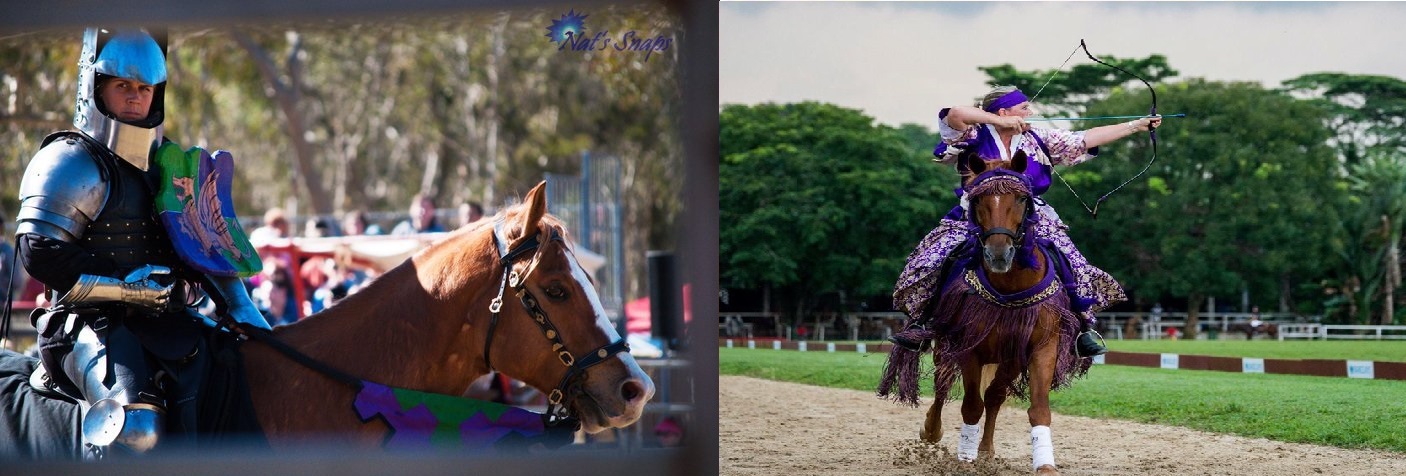


I started learning to fly in 1990 and in 1994 I was the Australian Advanced Aerobatic Champion. Still the only woman to have won that title here. 

I've been riding for over 40 years. and grew up in the western suburbs of Sydney. As a kid I loved jumping, Eventing was a passion, but I didn't bounce so well as I got older. My worst fall to date fractured 4 vertebra, as a result I got seriously into dressage in my mid thirties. But it gets a bit boring after my adrenalin sports.

I started teaching beginners to ride at my local riding school when I was 14 and have been teaching all sorts of horse riding disciplines ever since.

In 2009 I started Skill at Arms as something fun to do after seeing my first joust, but I thought jousting was crazy and really did not plan on doing that. 

A friend suggested we give horse archery a go and so we did, at our first horse archery show in April 2010 after only starting archery 5 months prior and shooting off a horse for the first time 4 months before the show. There is nothing like a deadline to make you get off your arse and get something done. 

I found this cantering along with no reins, not looking where my horse was going, and shooting my bow gave me more of my confidence back and I decided to try Balsa jousting. I was already winning a few local Skill at Arms events and had three of my horses trained in it. After about 5 weekends of training and borrowing a few bits of harness and quickly having some more made to fit me I did my first joust two months (June) later at Winterfest. My first pass was against an international competitor. 

I had a fun 12 months competing and doing shows in Sydney and one year later (2011) I won Australia's premier event the Abbey International Tournament of the Golden Fleece. 

In 2011 I did my first international Horse Archery competitions in Japan.This is where I got the idea to run an event on the beach. I also was honoured to be one of the first women and foreigners to compete at the Hirosaki 400th anniversary horse archery tournament. 

In 2012 My partner and I moved to Far North Queensland for a Sea Change ( it took as a week to drive up with the horses and trailers. It is a looooong way) I was fortunate to meet Derek Barnes who used to joust in England for 10 years and he showed me 'theatre' style jousting. Which we now do at shows up here as its too hot and humid to wear full plate harness. 

I had already started Medieval Horse Sports Australia to run competitions in Sydney for Jousting, Skill at Arms, Horse Archery and Working Equitation. After the move I continued to grow it and teach these skills as well. 

As there is more scope for horse archery to grow, and it suits my climate better, I have focused mostly on that, spending about 25 weeks a year on the road teaching around Australia and New Zealand and usually 6 to 8 weeks away training and competing internationally. Poland, Iran, Japan, Korea, USA, Singapore, next year (2016) Sweden, and France.

I also started the Australian Horse Archery Association in 2013 and got the State and National championships started here. We also run the only international horse archery event in the Southern Hemisphere. Its Called Yabusame on the Beach and it is a Japanese-style course with targets that break when you hit them, on our local beach with crowds of over 5000 people coming to watch. 

My Wins to date are:

2010 & 2011 NSW Horse Archery Champion
2011 Second Winterfest International Joust
2011 Champion Abbey International Joust 
2013 Bronze Medalist at Hirosaki, Japan International Horse Archery tournament
2013 & 2014 Australian Horse Archery Champion
2014 Bronze medalist at Grodeck Horse Archery competition, Poland
2014 Silver Medalist World Horse Archery Championships (Korea) for Masahe
2015 Dual Gold Medalist World Horse Archery Championships (Korea) for Masahe and Mogu 
2015 Reserve Champion Australian Horse Archery Championships (beaten by one of my students)

Motto-"Singular Laude," Which is Latin for "Dare to be Unique."

 Katrina has been a part of, or founded several organizations-Medieval Horse Sports Australia:

https://www.facebook.com/Medieval-Horse-Sports-Australia-207829159242166/timeline

The Knights of Camelot:
https://www.facebook.com/Knights-of-Camelot-134080663436507/?fref=ts


United States of America:

Amy Graham: West Jordan, Utah.

Live Steel fighter, IMCF Team USA Gold Medalist Team 2014, and returning to Team USA 2015. Gastric Bypass Bariatric Surgery Success. 


From Amy's Blog:
http://badassvalkyrie.com/

"That’s what I love the most I think…knowing that I can be a role model for someone out there who didn’t have any idea this sport even existed."
~And~
"Those moments when I can’t bear the thought of being encased in armor, or confined by steel & leather, knowing I will end up face down in the dirt more than once…it's the love of this sport and the look of wonderment in the eyes of every woman and every little girl, that has ever come up to me excited because she knows she can learn to be a Knight, too."

Australia:Skye Burnie: West Hoxton, New South Wales.

Sword Fighter, Fencer, Interior Design Student.


"I started off doing the lighter reenactment until I met my partner Bryce and he introduced me to full contact fighting and Battle of the Nations. I went to a couple of his training session and he showed me several videos and I was hooked! Not only was this a more involved historical fighting style but also the fact that it was treated as a sport and not a mere hobby got my blood pumping, none of this reenactment tappy tap and limited strike zones. 
I especially enjoy the group Combat/5v5 fighting more than the duels and it's more to what the guys train in over here, I enjoy the strategy and teamwork involved in the bohurts."

On the difficulties of being a lone sword fighter:

"
What has been the hardest part of being a competitive sword fighter? I think the hardest part is not having a lot of people knowing that this is a sport, it wasn't until this year that our Sydney- based team (Team Havoc) had a huge influx of people interested and that was after we came back from Battle of the Nations in Prague. The last couple of years we've only had 7 serious fighters training every week which gets a bit tough when you're trying to work out group tactics. The other hurdle is just being female, there aren't a lot of girls out there that know about this and as much as I try to get it advertised in the last couple of years to try and get a training buddy some girls that do show up tend to lose interest after a month or so after they realise how physically demanding this sport is. I am happy to announce that within the last month we have picked up another female fighter who consistently shows up for training."


Kingdom of the Netherlands

Esther Veldstra: Heerenveen, the Netherlands


BOTN/Bohurt/IMCF sword fighter, viking age living historian, Functional analyst in software, mother of two boys.


I do Full Contact medieval combat. Mostly duels, but profights and bohurt whenever I have the chance. I am the only female fighter in the Netherlands, so there are very few training opportunities. Bohurt needs at least 6 participants to make it interesting. Whenever I get the chance, I travel abroad to join events. 

Because there are so few opportunities to actually practice this sport in the Netherlands, I spend a lot of time doing cardio- and strength exercises. I picked up kickboxing to improve my stamina, footwork and reaction speed. I also spend a lot of time organising things for my fellow fighters and answering questions for those interested in joining the sport. 

I picked up my first sword almost four years ago. That's when I started training in early medieval, western style competitive fighting. Though it was exciting to do, I quickly grew tired of it. Mainly because a light tap on the shoulder was enough to beat someone. Since the participants are very lightly, or not at all armoured, you as a fighter are essentially responsible for your opponents bruises. I believed this type of sword fighting had very little to do with actual fighting. I, and a group of men who shared that idea, eventually just started doing full contact fighting and now the Dutch full contact movement is slowly taking shape. 

We sent our first team to Battle of the Nations in 2015. Though we got our asses kicked, we did have an unforgettable experience. Now, new members are joining our ranks and the sport is growing.

"United Kingdom of Great Britain and Northern Ireland". 

Francesca Terminiello: Greater Surrey Area, England.

Journalist, HEMA Instructor, Esfinges Administrator Europe


Francesca Terminiello is an instructor at School of the Sword, where she has studied Bolognese swordplay and rapier since 2010. 

Together with her husband, Piermarco, Fran gave a workshop at HEMAC Fiorentia 2014, the first of its kind teaching techniques from Giganti’s ‘lost’ second book of 1608. 

This is a work which Piermarco discovered, translated and published in 2013 with Joshua Pendragon. In March 2014 she demonstrated some of these techniques at a lecture delivered by Piermarco and Joshua at The Wallace Collection, London UK.

In 2013 Fran co-founded Waterloo Sparring Group, with members from HEMA clubs all over the south of England.


As ‘Agent in Europe’ Fran helps to manage Esfinges, a worldwide organisation for women in HEMA.

Here is a link to the HEMA School she teaches:
http://sword.school/

Here is the link to her Fencing Group:
http://waterloosparring.com/

Here is the link to Esfinges on Facebook.
https://www.facebook.com/EsfingesHEMA/


United States of America:

Sandra Lagnese: Columbia, South Carolina.

Soldier, Mother, and Live Steel Sword Fighter.


Mother of two sons, 10 and 8 years old. US Army Veteran, now in South Carolina National Guard (recently activated during historic flood and flood relief efforts). Gold medal winner on Team USA 2014 Castle Belmonte International Medieval Combat Federation Tournament. Co-Founder of the Palmetto Knights, a Live Steel Sword Fighting Organization. 

From their website:
"Palmetto Knights, headquartered in Columbia, SC and supporting the greater Southeastern region of the USA, is a non-profit organization dedicated to a holistic and inclusive approach to the research, training, demonstration and competition in various forms of historic martial arts both domestic and international."

Sandra even helped to craft her own armour based on XIV Century French models. 


"I break gender roles because I always wanted to be a knight. And I served my country and I continue to do so."

Palmetto Knights Facebook:
https://www.facebook.com/palmettoknightshsct/

Palmetto Knights Website:
http://www.palmettoknights.com/


Bess Mortimer:  Dual Citizen of Canada and USA!

Knight SCA, Viscountess SCA, Women's Team Leader/Captain Team USA Belmonte Spain 2014.


Bess Mortimer is one of the few women knights in the Society of Creative Anachronists. The count is currently at 43 Female Belted Knights in the entire society. Which incidentally is one of the largest standing armies in the world. She consistently led her team, Team USA, by example. 

{At the 2014 Castle Belmonte IMCF International Tournament, she voluntarily stepped aside, so ALL members of her team would have a chance to fight and participate.}-Reported by several members of the team and observers. 

"I have always lived by two statements. One- Just because it's hard doesn't mean it's impossible. Two- Above all be true. This ties into part of my knights oath "to ever be a good knight and true" and finally from the saying " to thine ownself be true.""

Sweden

Caroline Egemalm: Uppsala, Sweden.

Historical Reenactor, Historical Archer (XV Century Burgundian) XIV Century Knight Reenactor/Jouster. Trainer. Mother.
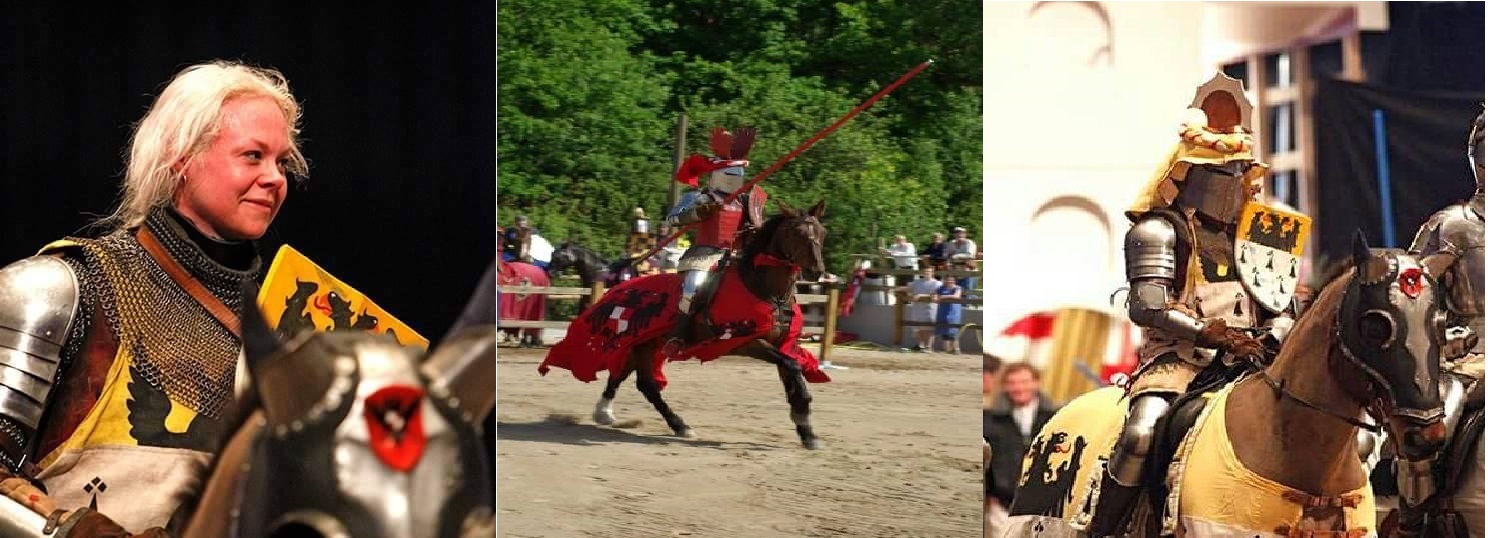


I started riding at the age of 6.


Showjumping and dressage has always been my prior alignment, but have tried hunting, eventing, WE etc.


In -96 I tried jousting for the first time and was hooked!


The horse I'm jousting with is my 16 yr 

old thoroughbred/connemara cross gelding, named Lindens Martell.

Started jousting in 1996.
Currently jousting with a XIV Century Harness or Suit of Armour. In the process of updating to XV Century Gothic Harness.

Since I live on a farm with 2 kids, 11 and 13 yo, and run my own company as a hairdresser, I nowadays only do the competition jousting
and some archery.
I've been jousting in Sweden, Finland, Norway, Denmark, Lithuania, Belgium, France, England, 
New Zealand, Australia and Poland, my favourite and second home.

A sneak peek at my achievements
-08 1st Joust Hackaland, Belgium
-08 1st Skills-at-Arms Hackaland , Belgium
-09 Best Horseman Award Harcourt Park, New Zealand
-10 3rd Joust Gniew Tournament, Poland
-10 1st Skills-at-Arms Gniew Tournament, Poland
-10 3rd Joust European Championships Horsens, Denmark
-11 1st Skills-at-Arms Tournament Tourney, England
-11 1st Mounted Archery Tournament Tourney, England
-13 1st Joust Arctic Equestrian Games, Norway

On her philosophy on life and jousting:
"To prove that I can handle the task at least as good as anyone else. Perhaps it's mostly for myself. When I do something, whatever it is, I want to do it as good and accurate as possible. If I feel that I can't, I won't do it. It's not about winning, but to do it as I wish it should be done." 

When asked about her children squiring for her Egemalm replied, 

"Haha! Not really. Alva helps me out with the horse.They were born into it, so we try not to force them to do too much in the medieval circus, unless they want to."

Federal Republic of Germany

Melanie Grass: Boppard, Germany.

Medieval Full Contact Fighting and Show Fighting for Reenactment Markets.


Medieval Full Contact Fighting and Show Fighting for Reenactment Markets!  I fight in Germany, with Club Zitadelle e.V., Team Hessen. Show fighting with my reenactment group "Freie Halunken".

Once or twice per week training with some guys, especially with my trainer Malte Karnatz and three days per week in a fitness center working on my endurance and strength for this sport. 

Whenever I can, I travel around Europe and join tournaments or reenactment events. 

I love doing sports and I love the middle ages,  so I think historical sword fighting combines both perfectly. Besides, I've always loved competition, but none were previously connected as intense and with as much fun as full contact tournaments has with me. 

I have been show fighting for 3 years, full contact 1,5 year

And last but not least... Each volume will feature a photographer who makes the shots, and captures the moments which make all reenactors and medieval enthusiasts look good. For that we are all thankful.

Susan Sumer: Unterschleißheim, Germany.

Living Historian, Reenactor and Photographer.


I live near Munich in Germany; reenactor, fencer, fighter , photographer.

I’ve been interested in the life Medieval for quite some time and started to do Historical European Martial Arts about 5 years ago, mainly fencing with longsword, rapier and sword & buckler.

Gradually I became more and more interested in serious reenactment, mainly late medieval (end of 15th Century) and Early Medieval (mainly Danish and Kievan Rus 10/11 century) and also fencing and fighting within medieval events.

In Early Medieval Reenactment you have plenty of women fighting, either as man (as I do) or in women's clothing. In late Medieval this is not common at all and in several events you unfortunately are not allowed to wear men clothing and armor as a woman. 

I’m also a photographer with more than 10 years of experience, and I especially like to photograph medieval events, camping, fighting etc. It’s always difficult if you want to combine participating yourself in a battle and also trying to make pictures at the same time. But I love to capture the atmosphere of an event or a battle with my camera and try to impart this atmosphere with my pictures.

I love reenactment. It means doing research, and then reconstructing something as close to the original as possible. E.g. I use to dye all my fabrics myself with plant dyes that are documented for the respective time and then sew everything by hand with original stitches.

In closing I would like to thank each and every participant in this series. Originall as stated earlier it was intended to be a much smaller article. I for one am glad to overwhelmed with examples of Awesomeness. 

Thank you for visiting our blog. Please stay tuned next week when we publish Modern Medievalist Women of Excellence Volume #2! 

-DS Baker

Saturday, April 11, 2015

Profile of Excellence Irina (Ira) Rogozovsky of Team Israel.

Modern Medievalist, (Facebook) allows me the opportunity to meet a wonderfully diverse collection of interesting people from all over the planet, (in a virtual setting.) I am a big supporter and proponent of women in athletics. As the world of international tournament fighting goes, the women who are involved in it right now, are all uniformly trail breakers, and they are making it possible for future women to compete.

A chance meeting online where I wanted to talk to a female athlete, has turned into a very nice interview. I bring you today, Irina (Ira as she likes to be called) Rogozovsky of Team Israel. She took the time from her Geography/Archaeology studies to visit with me earlier this week, and here is our conversation. Thank you.

Ira Rogozovsky carrying the national flag for Team Israel at the BOTN World Championships in Croatia 2014
(c) Battle of The Nations-Women's League.

DS: Ira what part of the world are you from? Meaning were you born in Israel or from someplace else?

IR: I have lived in Israel for the past Twenty Years but, I was born in Latvia.

DS: Military service in Israel is compulsory. Have you served or are serving?

IR: Yes I was active duty for several years and now I am a reservist. I will be in the reserves until I am age 45. At first I was in the Infantry, and now I am in a rescue unit that helps people who have had say buildings collapse on them, from an earthquake or other natural disasters.

DS: Did your military training help you with learning to fight in the Battle Of The Nations, (BOTN) world of tournament fighting?

IR: Yes and no. Krav Maga teaches you how to do arm and hip throws and kick someone in the testicles or gouge their eyes out. Only some of which we are allowed to do. This is for fun. Not life and death.
Practicing Leg Strikes.
(c) Michael Khananashvili

DS: What made you want to be a medieval tournament fighter?

IR: Actually it was an accident. I was hitchhiking in Poland. A guy from Team Poland, gave me a ride, and during the trip told me all about this style of medieval fighting. He made the connections for me with Team Israel and I came to one fighter practice, and I have been doing it every since. I love to compete and I love to fight, fight, and fight! I try to make every tournament and meeting I can.

DS: What do you like the most about sword fighting?

IR: I do mostly Bohurt, I like the teamwork it requires, the feeling you are not alone on the battlefield, the trust that is required among team members, the strategy and tactics you have to use... all of this makes Bohurt a wonderful sport in my eyes.

Ira and fiance Michael Epelman fighting together at the Kievan Rus Park
in September of 2014
(c) KMabirim

DS: What has been the biggest obstacle for you to overcome thus far?

IR: I think the biggest obstacle for me has been the fact I am a woman. I am the only women in Israel that fight in Bohurts (we have one more women, but she do only triatlon). So at first it was hard to train with the team, because they didn't take me seriously, and their attitude was like "we don't hit women"...so I found myself unable to train properly. But after some time had passed and I wasn't going away they (the men) got use to me and I became better, and as I improved the men started to see me as part of the team, and hit me like everybody else.

When we were in Ukraine in the "Call of Heros" tournament, one of the teams there refuse to fight with team Israel because I was in the team. But in the next tournament we fought in the Ukraine they invited me to fight along with team Israel, so I guess they accepted me as well. It has been a process to earn respect.

DS: Hmmm. It is funny how culture differ around the world. In America, I figured if a woman stepped onto the field of battle she wanted to be taken seriously. I would give her all the respect she wanted and all the hits I could send her way. One of the many persons who helped me learn how to fight was a woman. She beat the crap out of me on a regular basis... In ancient times, in the Celtic Culture, some of the greatest warrior teachers were women. The most famous Irish warrior in the world was named Cuchulain and he was taught how to fight by a woman named Scatha from Scotland.

IR: In the Slavic cultures it is a big problem to hit women. They don't understand that women can do sport as well or want to do the same sports as men.

DS: How popular has Battle of the Nations become in Israel?

IR: There are not a lot of fighters here, I believe that we have around 50 active and inactive fighters, and we try to invite new people all the time. We are also self funded. I am a college student with a part time job, as is my fiancee who is the co-captain of the team.

DS: You recently had a tournament. Excuse me, an international tournament how did you do and how did team Israel do?
Ira doing her Crossfit training in preparation for her fight with Darya Ignatenko
of Belarus.
(c) Crossfit of Israel.

IR: It was a pro-fight tournament. I was fighting Darya Ignatenko from Belarus and I won this fight.

https://www.youtube.com/watch?
v=XBe_udx2znY&index=2&list=PLhNEBIS4a7NKEEESIdB63u02uRUmBQU3k

DS: I remember watching this fight. She was a good opponent but, she looked like she lost her stamina in the second round.

IR: Exactly.

DS: How did you train for this fight?

IR: I did Crossfit Training especially in Cardio and I went to fighter training two to three times a week for almost six weeks straight. I eased up on my training the week before the fight, in order to ensure I didn't hurt myself by over training.
Conditioning is one of the biggest portions of fighting. If you can't lift your shield or swing your sword/chopper/halberd then you are done.
Ira Rogozovsky (R) preparing to launch a shield strike against Darya Ignatenko (L)
at the World Medieval Fighting Championship.
(c) Sergey Demyanchuk

DS: When you are fighting melee' with the team how do you communicate? What language do you use?

IR: Actually we have three languages we use. We use hand and arm signals adapted from our military training. Then most of us speak Russian, and lastly we all either speak or understand Hebrew.

DS: Have you tried to recruit your fellow female reservists to the team?

IR:I have. So far there hasn't been too many interested. We are a small country and our team is small. We are growing but slowly.

Leg Strike Training Pays Off. Ira (r) against Darya Ignatenko (L)
at the World Medieval Fighting Championship
(c) Daniel Skakun

DS: What has been the most surprising thing you have discovered since you started fighting?

IR: Halberd blow to the head.

DS: Well I suspect that must have been very surprising! But I am not sure it is a good thing.

IR: It was very surprising. Makes you reevaluate your training methods.

DS: Is there anything you would like to say to the women of the world?

IR: Yes! You have to have the will to fight. With it, you can overcome the training. You can get used to the armour bites and the bruises. It is actually easy if you want it. But if you don't have the desire or the will to push through, then you have no business in the BOTN or Bohurt fighting.

Ira Rogozovsky and her World Medieval Fighting Championship Cup.


Thank you Irina (Ira) Rogovsky for taking the time to talk to Modern Medievalist. We appreciate your time and the insights you have shared with us. All of our very best!
Shalom.

DS Baker.

Here are video links to Team Israel and one of Ira's fights with Skye Burnie of Australia.

Team Israel:
https://www.youtube.com/watch?v=PsMYTrF3BOI

Irina Rogozovsky (Israel) vs. Darya Ignatenko (Belarus)

https://www.youtube.com/watch?v=XBe_udx2znY&index=2&list=PLhNEBIS4a7NKEEESIdB63u02uRUmBQU3k

Irina Rogozovsky (Israel) vs. Sky Burnie (Australia) World Championship Demonstration Fight in Croatia 2014:

https://www.youtube.com/watch?v=YkW2MRy-Pkg


Irina Rogozovsky Winner of the Israel Challenge Pro Fight.
(c) BOTN-Women's League.


Saturday, April 4, 2015

Dark Age Fiction with M Harold Page.


Today's post is an update and a continuation of an on-going conversation with my friend M.Harold Page we have had for the past several years. Like most good friends we pick up where we have left off as if, it was a pause in the conversation while one of us goes to the fridge to retrieve a cold beer. We started our conversation about the new Young Adult novel downloadable from Amazon he just finished. Titled- (Shieldwall:Barbarians.)

http://www.amazon.com/dp/B00VAMJ5FS

(c) Jacques Marechal
DS: How long have you worked on this project?

MHP:Think I wrote it in a couple of months. It was a while back. I delivered to my agent, but then got caught up in writing novels for Paradox Interactive. It made a very good audition piece though. It took about a week to edit and tweak it ready to go out on Amazon. I put a lot of reliance on my network of beta readers, mostly fellow writers at my stage.

DS: What was the impetuous for writing a dark age novel in the first place?

MHP: You'll laugh.

DS: No mate, I won’t laugh. (holding my crossed fingers behind my back.)

MHP: My son Kurtzhau liked Romans back when he was cute and 8. And he wanted to know how the Roman Empire fell. I did this at University, but couldn't remember the details, so I delved into some books and... Holy S#$%!

DS: Holy S#$%???? What does that mean?

MHP: There was this battle - Chalons - in AD 451, that was like Ragnarock. About the size of Waterloo. Everybody showed up for this fight. The chronicles have 100K men DEAD ON THE FIELD.

DS: What was the old Norse line? The Crows feasted well that day…

MHP: Yep! KIA numbers were an exaggeration, but whatever you divide by, you end up multiplying again to get the number of combatants. Just like Waterloo, everybody was too shocked on the next day to do anything. And in reading about Chalons, I read about Aetius - basically Maximus - and the Germans and the Huns… And here was this wild amazing history, with a war out of Tolkien, and I just had to write a story set in it.

MHP: Barbarians! - book 1 - doesn't take us as far as Chalons. Instead it puts the hero at the Siege of Orleans, basically Helms Deep. In fact I'm fairly sure JRRT used Orleans as his template for that. So that's why I wrote a Dark Age adventure. Plus I'd been listening to a lot of Viking Metal

M Harold Page on the right during his Shield Wall Breaking Days.
(c) Richard Taylor.

DS: What made you settle on a Jute as a main character?

MHP: Well my Dad is from that neck of the woods in England.

DS: There is a Jutland in England? Pardon my geographical ignorance.

MHP: Mostly it was because I settled on Hengest as the main character. He's real. Jutes settled around the south of England. There were a couple of pockets. Mine are near the mouth of the Thames estuary. They and the other Germans were there as "security contractors" to the Romanised Britons. Didn't go so well, long term

DS: Thanks for clearing that up. (For a moment there I thought I had slept through another lesson from school.) You know in Friesland, there are pockets of languages where you can just show up and start talking to the natives and they understand English, and with a little bit of effort you can make out Friesian.

MHP: Not surprising. English is an odd language. Successive waves of Germanic barbarians basically spoke baby language to their subjects, and it stuck.You know, few verb endings, dropping the gender of nouns, that kind of thing. Basically you and I are speaking like comedy barbarians to each other.

DS: Gaaar! Me hungry! OK all BS aside, you have us set firmly in the Dark Ages. For the readers who might not know, explain why it is called the Dark Ages please?

MHP: Mostly it's Dark because it's hard knowing what happened then. Nowadays, Early Medieval is the more Politically Correct term. Once upon a time, historians thought everything between the Fall of Rome and the Renaissance was "Dark" because it sucked.

DS: Hahaha that was the explanation I was looking for. You know Gaul suffered less of the Dark Malaise than most former Imperial Colonies. It was such a cool place as far as your average barbarian went, they basically kicked the Roman landlords out, and said to the peasant class, "Carry on. We'll be around this coming harvest to collect the tax just like the last guy did."

MHP: Lots of continuity. Best deal was in the south where the Visigoths settled and ran things. However Late Rome was already pretty feudal. No togas, lots of personal household troops.

DS: Anyone who didn't like the new management plan would be dealt with the same way they (Visigoths) dealt with the Romans. At the point of a sword.

MHP: Visigoths, however, were crazy ass barbarians One king was ambushed while undergoing blood letting - otherwise he would have been armed. Before he died, he took out several of his assassins using a STOOL.

DS: Well the Visigoths might have been crazy but they did start two of the most powerful kingdoms in what would later be called Spain, those of course being Castile and Aragon.

MHP: Yep. And it's a hairy, murderous lineage. Or noble, manly and proud. Take your pick. I speak as one descended from the pagan riffraff that settled England. Our lot were mostly the stay home Germans who didn't get involved with the Roman Empire until they packed in ships and turned Britain into England.

DS: Well you are not the only one. I am descended from the riffraff that left England that was descended from your riffraff. (Or kicked out, which might be a better way of describing it.)

MHP: Who says genealogy can't be like a Viking Metal ballad?

DS: No one! Or at least not me. Back to your novel. What was the biggest stumbling block you encountered while writing your story?

MHP: Describing tactical situations. Pre-Technology Commanders don't get pretty maps, Heads Up Displays or a view from a Helicopter.

DS: OK for the young reader out there, define Tactics vs. Strategy.

MHP: Strategy: We'll push down this river and find a town to sack.
Tactics: Oh sh#$% they're shooting at us! Take cover while I try to burn the gates.

DS: I will say this much, the story reads as a primer one would use to train platoon leaders and young platoon sergeants on how to lead. And I mean this as a compliment. It is not dry or boring by any stretch of the imagination. For long time or old time gamers it feels like you are involved in a game of Platoon Leader © Have you ever fought in a shield wall yourself?

MHP: No. But I have broken one, at a mixed era reenactment event.


(c) Jacques Marechal


DS: Wow! There has been a lot of discoveries in interpretative history, where previously held ideas have been rudely shattered. I have read where scholars utterly dismissed dark age or even middle age accounts of life in a shieldburg. I personally have seen two hundred plus fighters running full tilt hit an old fashioned Anglo-Saxon style shield wall and...bounce! I bet that was hard to convey to your readers.

MHP: But from a WRITER pov, this is a problem. A lot of people have a lot of ideas, some of them strongly held and based on experience. The Romans certainly took the wedge seriously. A lot of their manuals are filled with how to receive a shield wall or fighting wedge. Their manuals talk about forming inverse wedges to receive them.And so on. A lot of kinetic energy spent by both sides seeing who could shove the other guy around the battlefield.

DS: The annals of history are replete with infantry fights turning into slowly revolving wheels of death. Where at the end of the day’s fighting the victors might find themselves on the complete opposite side of the battle from where they started from.

MHP: Intimidating isn't it? What our ancestors could do while other people were trying to kill them at the same time.

DS: Yes it was. Especially since most of the people who fought in the shieldwall of the dark ages was not a professional fighter or soldier. They were farmers and millers and bakers.

MHP: Go to the Bay of Marathon some day, look at the monument raised to the shopkeepers, farmers, cobblers....who faced the rest of the known world and won. Forget 300. Marathon was the battle. You had to be tough back then.

DS: Why YA or Young Adult Fiction?

MHP: Initially, so my son could read it From a literary point of view... well, YA is the last bastion of old fashioned adventure yarns. I've been reading a lot of Harold Lamb and wanted to give it a go. Shieldwall is also pretty much "in the tradition of" the YA writers I grew up reading. There's this writer Ronald Welch who wrote incredible military stories for boys. Welch won the Carnegie Medal for "Knight Crusader" which makes you *feel* Hattin  Yes a big chunk of Howard as well. but that takes ,me onto the other thing Too much YA for boys is either "teamplayer" or "sole operator" stuff

The Battle of Hattin-XV Century French Manuscript.


Just like Conan isn't really much of a leader, beyond "Rah follow me while I wade in blood do try to keep up"
I wanted to do like Ronald Welch and Rosemary Sutcliff and write a book about leading: You're in charge. Now what?


DS: Leadership is a horse of a different color to write about. It is normally something that in my opinion very few do well. It is hard to give an inner monologue and keep the action flowing at the same time. Both of which you do very well in this book.


MHP: There are no certain prescriptions one can offer, except to think about the people you are leading. In the case of my story, my hero has to deal with his rowdy men, his murderous rivals who want to frag him, interactions with other forces, unit tactics taking all that into account, oh and battlefield management while smiting.


DS: I would like to thank my friend M Harold Page taking the time to talk to me about his latest book. More importantly to give a wonderful unfettered conversation. Rarely does this happen in our hurly burly world. For those of a military bent, be you a young leader of men or seasoned pro, I put this adventure story right up there with the lessons taught in “Defense of Duffer’s Drift.” by Maj General Sir Ernest Dunlop Swinton. It is a rollicking good read and it will help those so inclined to think their way through any number of problems. Although I don't advocate using a sword to lop the heads off of your opponents!
M Harold Page's personal blog can be found at:
http://www.mharoldpage.com/

Jacques Marechal, photographer par excellence, his website can be found at:http://www.marechal-jacques.be/


Wednesday, February 18, 2015

The Newest Monarchy in the World and the Birth of a Nation!

HSH Gerard, Fürst von und zu Rheinbergen or HSH Gerard, Sovereign Prince of Rheinbergen.


Today we have a rare opportunity. We are witnesses to the very beginning of a new nation and the revitalization of a noble house into a royal household. Rarely does this happen. The last time I remember it happening was when South Sudan was formed after years of bloody civil war and the western powers interest in developing the oil beneath the new country. We are seeing history in the making.

There is no bloody conflict. There is no Oil or Natural Gas at stake. But what is at stake is the health of an ancient ecosystem and the global community that has a vested interest in its remaining viable and sound.

The Principality of Rheinbergen has announced today with this interview it is ready to step forth on the world's stage and take its place amongst the brotherhood of nations. It shall be led by its Prince and First of his name, HSH Gerard, Fürst von und zu Rheinbergen or HSH Gerard, Sovereign Prince of Rheinbergen. Who has been gracious enough to have a conversation with us today.-Thank you very much your Highness.


The official coat of arms for the Principality of Rheinbergen
Fürstentum Rheinbergen


Q: House Cornielje Your Highness... How old is your family and where does it come from?

HSH Gerard
A:The oldest known ancestor is from 1497 in Rouen France

Q: And the the first ancestor to be enobled?

HSH Gerard
A: Pierre Corneille d'Anville, ennobled in January 1637 arms granted in March of that same year.
He was the father of the famous playwright that's 378 years ago.

Q: So your family has been around for roughly 500+ going on 600 years.

HSH Gerard
A: Yes indeed, the oldest known ancestor owned a tannery in Rouen in the late XV Century.
William the Conqueror's mother Hervleva,  her father and William's, grandfather was a tanner by the way. Sometimes countries and dynasties have humble origins.

Q: Why form your own country?

HSH Gerard
A: The main idea was to create an alternative nation that emphasizes heraldry, art and the environment. Another important factor is politics: I think democracy is not working as it should, and now a secure hereditary monarchy is a better answer.Where one person is responsible who cannot be purchased for a better positioning in a market by a large uncaring or non responsible corporation. Or for a country who removes itself from the courts of law, in order to run roughshod over its citizenry.

Editorial insert in the conversation*(Oddly enough, Otto von Habsburg felt that the world would eventually return to Monarchy with a stronger role for a Monarch than just that of a figure head.)

HSH Gerard
A: I agree, with the Grand Duke.

*(Although he liked a strong personal monarch with a subservient house of lords and commons, not the other way around.)

Alp-Rheinbergen. Runs from Thomasee till the Bodensee over 172 km. Neighbouring countries are Switzerland, Liechtenstein and Austria. Major cities near: Feldkirch, Chur and Dornbirn.


HSH Gerard
A: I believe that is correct, Democracy as we know it does not work due to a lack of education and there is corruption in many facets of modern society. A strong enlightened monarch can control this, by being solely responsible for their nations well being. The world needs strong leaders with vision, passion and compassion.

Q: Do you see your version of a Monarchy similar to that of Liechtenstein?

HSH Gerard
A: Yes, I do: The power of the ruling family there has increased over the last decades and it has benefited the country greatly. Yet the people of Liechtenstein retain representation and are happy living inside a principality.

Hoch-Rheinbergen runs from the Bodensee up until Strasbourg over 207 km. Neighbouring countries are Switzerland France and Germany. Major cities near: Konstanz, Schaffhausen and Basel.


Q: How did you settle on the Rhine / Rhein River as the basis for your Principality? Kingdom?

HSH Gerard
A: I grew up in the Rhine area, just a stone throw away from its shores. It is a region close to my heart. There is a mythical beauty that surrounds the river Rhine. For decades it looked as we would lose this natural beauty, but in the eighties the tide turned and the river started to recover slowly, but there is still much to do. I envision the micronation of Rheinbergen as an active country with active citizens willing to work on further improving our river nation. We are a Principality not a Kingdom.

*(Thank you, your Highness. I needed that clarification. I think some of my readers might have a fascination for Royalty but in America at least, the proper protocol and usages of address have fallen by the wayside.)

Ober-Rheinbergen runs from Strasbourg up until Mainz. It has France and Germany as neighbouring countries. Major cities: Strasbourg, Baden-Baden, Karlsruhe, Ludwigshafen and Mannheim.

Q: Do you think the Rhein river countries will accept a new Principality in their midsts?

 HSH Gerard
A: I think they will: we are not claiming any actual territory: the riverbed and the shores belong to the countries the river flows through ... however, the river itself does not. The water flows freely from one country to another. Not a single drop of it is owned by one of the neighboring countries. There is where our claim lies and there is where we can defend our claim without invading any foreign territory


Mittel-Rheinbergen runs from Mainz until Köln over 364 km. Neighbouring country is Germany. Major cities: Mainz, Köln, Wiesbaden, Koblenz and Bonn.

Q: You have obviously thought a great deal about this, once the surprise has died down, do you think the idea of a River Principality might become attractive to the EU as a way of maintaining and healing the Rhein? Because one nascent country would have a vested interest in its health and not be divided by politics, money and old national self interests which has plagued the six countries on the Rhine?

*(The Rhine flows through six countries -Switzerland, Principality of Liechtenstein, Austria, Germany, France and the Netherlands before flowing into the North Sea at Rotterdam.)

HSH Gerard
A: I think we could potentially give the six countries and the EU a neutral third party option over its maintenance, that heretofore they have not had. I hope and believe it will, if we can gather enough momentum and create a large active following that actually contributes to obvious improvements.
One way is through the use of Social Networking like Google+ and Facebook.


Nieder-Rheinbergen runs from Köln until Pannerden over 130 km. Neighbouring country is Germany. Major cities are Köln, Düsseldorf, Krefeld, Duisburg and Wesel.

Q: What steps do you see that are needed to achieve international recognition of Rheinbergen?

HSH Gerard
A: First of all a lot of active subjects who would spread the word and are actively promoting and researching a healthy environment. Secondly a large number of people that believe that this micronation is more than a quirky eccentric game. What I also see as very important is culture and art become a large part of what our national identity. We want to show the world it is possible to put an emphasis on beauty, art and nature in this world without being just dreamers or people with their heads in the clouds. The hard business like approach of capitalism is failing all around us. We need to be a beacon of beauty and compassion to the world, and with resolve and the effort needed, we will become so.

Q: How are you going to pay for it all?

HSH Gerard
A: Since we are a tax free nation, we count on our citizens to work actively in our nation. Rewards will not be monetary but in the form of promotions and honours. I believe that we can and will succeed in running this nation without large sums of money. Idealism, passion, compassion and hard work can replace hard coins.

*(In America we have a term for what you are describing it is called Sweat Equity.
No money exchanged but hard work and effort means you own something you have a part of the game not just a person who has bought their way into the poker match. You have earned your way.)

HSH Gerard
A: That is our vision exactly.

Neder-Rijmbergen runs form Pannerden to Rotterdam over 160 km. Neighbouring country: The Netherlands. Major cities are Arnhem and Rotterdam.
*(I think what I am afraid of is, Rheinbergen devolving into a Tax haven for international tax cheats like the Principality of Sealand did. So how do I ask that question?)

HSH Gerard
A: You just did! (smiling) Maybe ask me if I am afraid of the pitfalls of being a tax free country perhaps?

Q: Are you afraid of what pitfalls or downside might happen with a Tax Free Nation?

HSH Gerard
A: Not really. First of all we are a nation right in the middle of Europe and surrounded by neighbors with very strict tax rules. That makes from a pure logistical point of view a lot harder to establish a 'rogue nation' like for example the Principality of Sealand; which even in its national anthem openly advocates actions that are illegal in most countries. I count in the second place on the citizens of our nation to be proud of our values and to control themselves and check each other's actions for correctness and fairness, this obviously is needed without turning Rheinbergen into a 'big brother is watching' nation. This should and will all be based on our principles: education, passion, compassion and hard work. Finally: we are not a democracy, we are a hereditary monarchy with me at its head. Together with my council, family and citizens I will keep a sharp eye on the developments as they happen.

Q: I noticed your non announced national Facebook page has blown up, With 10K likes and climbing.

HSH Gerard
A:It has indeed. Which just goes to show how attractive a direct rule monarchy is to the people of the world. Modern governance as I said earlier is failing its citizens and subjects badly.

Q:Do you see an eventual issuance of passports for future subjects of the crown? I ask because that is one of the things that cause so much drama for Sealand. Fake passports were being sold on a black market to some truly unscrupulous and not so savory people.

HSH Gerard
A:We will issue passports in the course of the coming months. Although we may not be recognized yet, we do envision recognition in times to come and want to be prepared. The passports will initially only be used within the territory and frame work of Rheinbergen but we aim for international recognition in a foreseeable time.

Q: How do you want to be styled / called in public? Because as much as Americans love royalty, they have fallen out of using the proper terms and titles. I ask this in the name of all interested USA potential subjects.

HSH Gerard
The official style is HSH Gerard, Fürst von und zu Rheinbergen or HSH Gerard, Sovereign Prince of Rheinbergen. Both are fine.

*(Great! what does HSH mean ....?)

HSH Gerard
A: It is actually mirroring the style of Liechtenstein. His Serene Highness.

*(I had to ask. Americans other than the heraldry crowd are not used to post or pre nominals.)

HSH Gerard
A: Hahaha, I suppose you have fallen out of using titles; since it has been what? 239 years...

*(This is the portion of the interview, where I want my guest to touch on things I might have missed or failed to talk about at all. It allows our interviewee a chance to finish off their interview.)


The official seal of Fürstentum Rheinbergen.

HSH Gerard
A: I would like to draw the attention to our patronage of the arts. In particular music in all its forms and fine art in the form of heraldic art are great passions of mine, I therefore support these forms of art and we do have a number of great heraldic artists onboard. A few names: Neil Bromley, Benoit Billion, Tudor Radu Tiron, Carlos Navarro, Laurent Granier and Danilo Carlos Martins. Most of them even became citizens of Rheinbergen. As did David Warin Solomons, our Court Composer. A phenomenal musician, conductor and composer.

*( In an off venue conversation HSH Gerard expressed his desire to see funds set aside for students who wish to continue their education in art schools, and performing art conservatories.)

Concerts and art exhibitions, tourist venues along the Rhine can be used to promote third party approach to the various ecological issues currently plaguing the Rhine. With a potential reporting office, that could contact the European Union's office of Transportation and the Common Agriculture Policy group.

We have a real opportunity to declare a new nation. Start from nothing and work upwards, without having to fire a shot or commence a bloody revolution. A peaceful nation based on cooperation, art and liberty.

Here are the links to the world's newest micro nation.

Facebook:
https://www.facebook.com/pages/Rheinbergen/774137879329320

On the web:
https://www.rheinbergen.de/home.html


.