Thursday, October 3, 2013

"Are you a Blue or a Green?"

     "Those who cannot remember the past, are condemned to repeat it."-George Santayana
Horses from the Hippodrome of Constantinople
Wikipedia Commons
Photo by Tteske.


     I woke up this morning to find the scent of burned Hickory wood on the breeze and airships made of Oak leaves floating by as if they were in some regatta sponsored by the Most Serene Republic of Venice. My morning thoughts are often travelers who upon having an unfortunate accident somewhere out at sea, find themselves washed upon some unknown shore. This morning they washed up on the shores of historic Constantinople...

     This is my blog. I try to write of things medieval in nature. However there are times when the story to be told goes much deeper into the timeline than what one would or could call medieval. I have a friend we will call John for this article. John is a pragmatic modernist, who believes that anyone or everyone who lived before the American Civil war belong to a large mouth category he calls "Ignorant, muck raking savages, living in their own filth and squalor."

     "It was only with the discovery of the modern medicine and the maturation of the industrial revolution did we evolve as a species. Before that it was only half seen glimpses of light amongst savagery.Only when that world died did we then become truly modern and civilized"-John the Modernist

     My last heated exchange with John came burbling up this morning as I thought about what he had said. We have had many conversations about what constitutes a civilization,-educational enlightenment, art and culture, science, the ability to disseminate knowledge . All basic building blocks of developing or creating a bright future full of possibilities. John's opinion is that the generation born right after WWI ended, had won the historic lottery.-The golden ticket from Willy Wonka fame as it were.

     Right on the heels of those thoughts came a history lesson I learned as a precious child, involving the Byzantine Emperor Justinian, Empress Theodora and the Charioteers. Chariot racing had always been popular with the Greeks.-Four horses pulling a man on a small light cart around a race track at high rates of speed was the ancient version of NASCAR. It was terribly exciting. As in NASCAR when a team of horses and their charioteer crashed there was blood and death. If you have ever watched the movie Ben-Hur, you have a fair grasp of what a race at the Hippodrome looked like. As with many things of a Greek origin, the Romans absconded with the idea and promoted wildly. By the time, the Greek, ahem... errr.... Roman Empire in the East came into being, it had all but replaced the Gladiatorial games as the most popular sport in the empire.

     I can even imagine Greek Polis Rednecks in the audience talking to each other, "Yeah Niko, if dem der boys from Alexandria aint bumpin' den it aint racing! Know what I mean?"

     Like a lot of sports, it had its fanatical adherents, and soon associations were formed. Imagine football hooligans armed with swords and knives. The two largest groups were simply called the Blues and the Greens. These "associations" became so large, that they became political. Soon the senatorial class, was being courted and wooed by the various fractions, and shortly thereafter the leadership of these groups had been suborned by the very people they had thought to control.-The Senators.

    The end of  531 AD saw Emperor Justinian in a tight spot. He was in the process of negotiating a peace treaty with the Persian, and having to raise taxes at the same time. The proposed peace treaty was not altogether popular amongst the Polis (people) and the raising of taxes was hitting the aristocracy pretty hard, not to mention they were being marginalized by the Emperor. This situation had simmered for most of the year.

    On January 13 532 AD  Justinian opened up the Hippodrome for racing. The Hippodrome was attached to the Royal Palace and the Emperor had a secure passageway to his box where he could oversee the racing. As the races kicked off, a riot broke out between the Blues and the Greens. The Blues were quasi allies supported by the Emperor, so long as their goals and political aspirations were seen to, and the Greens were in the pockets of the Senators. The Green party quickly gained the upper hand over the Blues.  They then held forth a new Emperor, the nephew of the old Emperor Anastasius I  a simpleton named Hypatius. The Greens then began an assault upon the royal palace which lasted for five days.

     The mob of militant charioteer fans, spurred on by their Senatorial masters all but won the day. At one point it looked like the mob was going to actually break in and kill the Emperor and his Empress. Justinian urged his wife to take safe passage out of the palace and cross the Golden Horn to safety in Asia. She replied, by quoting an ancient Roman saying, "Royalty makes a fine burial shroud."

     Through treachery, adroit political maneuvering and the liberal application of bribes the Emperor Justinian was able to convince the Blues, to fight their way clear of the Greens and leave the Hippodrome; where both fractions had been using it as a sort of base of operations. As they did, the Army led by General Belasarius, entered. It was estimated that in the end, 30,000 Green supporters along with Hypatius and a large number of Senators were slaughtered. It took several weeks to drag the bodies out and dispose of them.

    The modern day lesson... Our country is prostate and weak. Our mobs, have been suborned by the very people they hoped to influence. I am thinking of the Occupy folks having lost their will and having their messages scattered to the winds, or to mangle William Shakespeare, "A tale told by idiots full of sound and fury, signifying nothing." And the total suborning of the Tea Party by the monied elite, who pursue their divisive tactics of using racist attacks and the fear of a white minority loosing their grip on political power.

     America has been easily divided by the colors Red and Blue. Or maybe it is Blue and Green? In either case, It is interesting to think on my friend John's argument over how civilized we are. My question for my American readers is: Are you a Blue, Green? Or are you able to transcend the mob mentality, think for yourself and decide you are an American first?

-DS Baker

Monday, September 30, 2013

"Mongols in America"

     I have often heard my friends lament that America did not have a medieval heritage like that of Western Europe. Although we were founded by western European powers, we might have had men with titles of Lord this or that, we did not have the history of knights or men-at-arms fighting great battles or sieges, with Catapults and Trebuchets flinging dramatic boulders at garrisons bravely defending their keep. But that is not to say we did not have an incredibly effective form of medieval combat that stymied Western European Colonial attempts.

    Anthropologists often will talk about a concept called parallel evolution. This is where disparate groups of humans often divided by large geographic distances or even epochs of time, develop similar technologies. The fate of the people who have tied their future to the development and nurturing of horses, allows for a certain set of variables that generally only differ in the actual time of the cultures development and their environment with which the people find themselves in.

    The Scythians were chronicled by Herodotus as one of the all time masters of what would later become the Southern Ukrainian and Russian steppes. Their descendants became the Sarmatians to the Romans and later in the early part of the Medieval world, the Alan people. The Parthians were another horse culture. We have the Magyar of Hungary. And later the bad boys of the XIII Century, the Mongols. Not to mention the Persians who were the bitterest of foes to the Mongols.

     All of whom developed a strong horse bow, mounted archer form of combat. Along with lancers and horsemen who would throw lariats at their foes so they could capture their enemies horse. It was a constantly changing fluid form of combat. It could be effective in the extreme. Mounted horse combat involves a large degree of deception coupled with the ability to cover large amounts of distance in a short time frame with the ability to communicate, while using the local terrain to your advantage. Until the advent of the Walker Colt Pistol, it was also one of the most effective forms of combat man has ever developed. It also goes a long way to explaining why Cavalry or mounted armoured vehicular combat has stayed with us in one form or another to this day.

Mongol Horse Archers, circa 1430
Wikipedia Public Domain

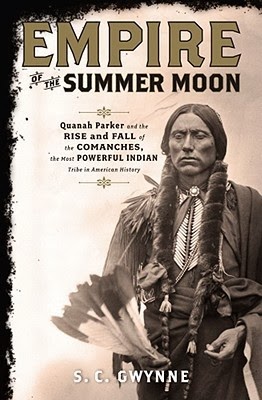
     Recently I was given a new book to read by my father. It is called Empire of the Summer Moon. By S.C. Gwynne. It is a vibrant read about the Comanche dominance of the Western American plains and what is euphemistically called the Comanche Empire. Gwynne tells how first the Spanish colonial efforts, later the French and even later still Texas authorities and settlers are defeated in combat by the Comanche bands.

    One of the things we need to clear up is the use of the word nation. The Comanche were a people, most of whom prior to 1680 were a part of the greater Shoshone ethno-group, Until they were able to get horses from the Pueblo Indians in their revolt against Spanish authorities. Shortly thereafter they quickly became a group with a separate identity on their own. But as a rule, they were not a nation. They were broken into several large groups or bands. They had leaders of the various groups, but the concept of a Chief was again something the white man placed upon them.

      Gwynne's retelling of the conflict with the Comanches is paralleled by his account of the Texas family named Parker. The Parker's built what could be called a palisade fort on the Texas frontier border not too far from what is the present day Dallas/Ft Worth Metropolis. In 1836 The Comanches along with several groups of Kiowas, Caddos and Wichita Indians attacked the fort. They killed several members of the Parker family and made off with Cynthia Ann Parker and her brother John Richard Parker. Cynthia Ann Parker was made a member of the Comanche band that had attacked her family. She eventually married a Comanche leader by the name of Nacona and had three children by him. One of who was  Quanah Parker, the last war leader of the Comanche.  

     Gwynne's telling of the four decade long struggle to conquer the Comanche details just how hard and brutal the war was. As much as we have seen movies like "Dances with Wolves" it was the defeat of the Comanche and not the Sioux which led to the development of the American West.

     The Comanches like the Mongols had been on a steep learning curve since 1680 when they received their first horse herds. The soon realized that mounted horseback archery and lance work were the most effective tools they had in their tool box. I won't give too many details about some of the battles chronicled in this book, but time and time again I am reminded of the tactics used by the Mongols in their invasion of Western Europe.

     If met with a large force, the Comanche would ride away, drawing out their enemies in long lines of running horses. they would fire Parthian Shots over the backs of their horses, to antagonize their opponents. When their enemies horses would begin to tire, they would suddenly wheel and begin liberally peppering their foes with arrow.-Several accounts in the book talk about white men firing off one shot to the Comanches five arrows.

     The Comanche were ultimately defeated by having their primary food source slaughtered almost into extinction. It should be noted the killing of the American Bison will go down as one of, if not the largest voluntary mass killings of a mammal in human history. The second force that caused their downfall was the emergence of XIX Century technology in the form of multiple shot firearms, coupled with a Government's iron will to see them either reduced entirely, or beaten to the point they would no longer have any influence or validity.

     I would give this book three out of five stars if I rated on that basis. It is my opinion that this is a good introductory offering into American History of the era. Although there is in my opinion too large of a reliance upon sensationalist newspaper accounts from the day and not enough of hard research. It is however a gripping read and one that I believe will keep you entertained.

-DS Baker


Here is the official website of author S.C Gwynne:

http://www.scgwynne.com/ 

Thursday, September 26, 2013

"To Search, To Strive, and Never Surrender!"


(c) Trevor Clemons

     Most of my friends from the past couple of years are friends I have made on the internet. We have usually met on one forum or another and as it were, serendipitously keep bumping into each other... Facebook has only added to the number of times I find myself stumbling across various acquaintances. One of these characters is my friend, a gentleman named Josh. 

     Through Josh I have met several new people, one of whom is a young man named Reece M Nelson. I messaged Reece Tuesday and asked him if he had wished Josh a Happy Birthday. He replied with a "Well so it is! And a be right back!" I have a friend with whom I served with in the Army, who reminded me a great deal of Reece. It is hard to explain but there is something that makes you instinctually like and trust my friend Bill. Reece Nelson has that same undefinable something my friend Bill does.

     Reece and I like armour. We like sword fighting. We both love history and are big fans of the XIV Century of nastiness that made up Western Europe and specifically the 100 years war. So it has been a great deal of fun for me to "get to know" Reece. During our message session on Facebook, on the spur of the moment I asked Reece if he would like to do a brief interview with me here on Modern Medievalist. I received a yes, and what follows is basically an edited transcript of our conversation. I think at the end of this interview you will find my young friend Reece M Nelson as remarkable of a person as I do.-Thanks buddy for the wonderful conversation.

Q: Reece M Nelson who are you and what part of the world do you live in?

A: I am 26 years old and I live in Overland Park, Kansas in the USA.

Q: You seem to be fairly tall and athletic with an angular build, what are some of your hobbies?

A: Mostly HEMA. I study both Blossfechten (unarmoured) and Harnessfechten (armoured) combat. Which can be a real workout. I also play bass guitar in a progressive metal band.

(c) Clarence James Wolfe

*For those of you who do not know HEMA or Historical European Martial Arts, is an exacting and physically demanding study of sword fighting techniques, to include grappling, dagger, long knife, quarter staff, Dussak, Polarms and Longsword.. The most popular forms are those created by Hans Talhoffer, Paulus Kal, and Johannes Liechtenauer. I will include a Wikipedia Link for those wishing to know more.

Q: Harnessfechten is armoured combat. Who made your harness? (Suit of Armour.) And what type of blades do you fight and train with?

A: Actually, the armour was made by myself with the help from the founder of my group. He had spent many years learning how to make armour and instructed me on my harness. There are a few pieces that I had bought, due to them being some of the more difficult pieces to make (hourglass gauntlets). I'll be getting a custom Bascinet helm later this year by Jeff Wasson. I'm very picky when it comes to form, so I try to have all of my pieces look just like the surviving examples. I currently use a CAS Hanwei Practical Bastard sword, as that it's a stiff blade, better suited for Harnessfechten. It being heavier, also allows me to develop better technique when doing Blossfechten. It helps develop a better "Push/Pull" motion with the hands.

Q: How long have you been training with swords?

A: Oh man...LONG time. I started off doing stage combat when I was 17, then started studying HEMA on my own at 19. Something like 9 years now. It wasn't until I had picked up a book called "Medieval Combat" by Hans Talhoffer that sparked my interest with understanding the realism in European fighting. That book allowed me to ask all of those important questions about arms, armour and the fighting techniques.

Q: Let's get down to the important question. What do people say or think when they realize their opponent is missing a limb, and would you be so kind as to tell how you lost it?

A: Having one leg is actually very beneficial for me, while bouting or fighting people let their guard down and think that I can't spring forward as much. Most people tend to think " I better take it easy on him" but I soon prove them wrong. I had lost my leg at birth, due to the umbilical cord, cutting the circulation to my left leg.
So I've never known any different. I'm the only person I know of doing HEMA with an amputation.
I hope to inspire others that may have the same disability to do something or let them know the world didn't end with a missing limb.

(c) Clarence James Wolfe


Q: What have been some of the more memorable instances where people were surprised by your prosthetic leg?

A: Well I seem to be a big hit with the kids at the local Ren Faire. Their parents come up to me and say "Thank you" when I take the time to speak or show my leg to their children. The most memorable one was a group of United States Marines who came up to me and told me of a friend of theirs who had lost his limbs and was really depressed. They made a video of me fighting and sent it to him. I later heard from them that he had been inspired by the video and had taken up sports.

Q: Do you belong to a Schola or Group like so many of your European brothers and sisters do?

A: We primarily train at the Holy Trinity Cathedral in downtown Kansas City, Kansas. I belong to The Medieval Swordsman Guild of Kansas City and I am a co-instructor for my group.
What is unique with our group is that we also do living history with HEMA.

Q: Have you developed a Medieval Persona to go with everything. As I seem to recall a certain German Knight who was missing an arm said some rather unpleasant things to an Archbishop once...

A: I haven't done my persona yet, but my group and I will be each having our own background that will fit with our attire for when we do history presentations. 
so far I've said I'm an esquire that had lost his leg in a battle, then continued service.

(c) Reece M. Nelson.

Q: So what does the future hold for Reece? 

A: Well I would like to continue teaching HEMA and possibly work out a way to do demonstrations or outreaches to wounded soldiers and even children who are now missing limbs. But things are going to be on the back burner for a while, I have a hernia operation in my future, but I don't have health care so... As it is I haven't practiced my HEMA training for over a month now. My other dream is to one day participate in the Tournament of the Phoenix, as a jouster.

I would like to thank my young friend for his time. This has been one of the more interesting conversations and interviews I have had in a while. Training, Teaching, Working out to HEMA drills with a prosthetic limb just has to be yet another definition of a true Modern Medievalist. -Thanks Reece.

Photo courtesy of Klehma. Reece M Nelson.


Here are the links to Reece's efforts, his group and his band. There is also e-mail addresses to get in contact with him and his friends.

To contact Reece and or his group:

contact@kcsword.com <contact@kcsword.com>

Website for The Medieval Swordsman Guild of Kansas City:

http://www.kcsword.com/


Reece has a YouTube Channel where he shows his various HEMA forms, for his students and to receive tips from other practitioners of the art:

http://www.youtube.com/user/VikingWannaBe51887/videos

If you would also like to see Reece rocking it out, here is a link to his band!

http://klehma.com/

The Wikipedia Link to their HEMA article:

http://en.wikipedia.org/wiki/Historical_European_martial_arts

Once again, thank you Reece M Nelson for your time and for the opportunity to tell your story.

-DS Baker


Tuesday, September 24, 2013

"Things" concerning the men who once sailed in Longships.

The Law Rock or Speaker of the Law
At the "Althing" of Iceland.
Painted by W.G. Collingwood
Circa 1826-Public Domain
     In the name of this blog are two elements.-Modern and Medievalist or Medieval if you will. Because I look for them, I see medieval links to our everyday existence. Most of Europe for instance is nothing more than a framework of modern governance overlaid upon centuries of tradition, most of whom are medieval in nature. I believe it is part of the human condition to keep our history and our heritage or the heritage of those from whom we come from alive, and relevant in our daily lives.

    As an example of people keeping their culture alive, year and years ago I was sitting in a pub with a good friend of mine from Carrickfergus, Northern Ireland. We were watching Ireland battle Denmark to a tie in a World Cup qualifying match. At the end, when Ireland has scored the tie goal, an Irishman at the back of the pub yelled out in a really loud voice, "That! For Clontarf!" My mate and I just about fell off of our bar stools laughing. Incidentally it took almost a thousand years for that little statement to be uttered...

     For those who might not know the Battle of Clontarf happened on  the 23 of April 1014. It was a battle between Dubliner Danes, Orkney Adventurers and a large collection of Vikings from all over the Scandinavian world. Vs. Brian Boru the then High King of Ireland. In the end the Danes and their allies were beaten but Brian Boru was killed by a group from Orkney fleeing the battle. The blood loss on the side of the Irish was so great, that very few Noble Irish Families did not have at least one family member die. -So it evolved into  a badge of honor amongst the Irish, to say they had someone die at Clontarf.-End the end, it resulted in a draw for Ireland with a dead king and a goodly amount of their nobles perished and the Danes loosing much of their assembled forces.

Battle of Clontarf
By Hugh Frazer. 1826
Public Domain.


    The oldest Parliamentary Government in the world exists in Iceland, called the Althing. Which incidentally makes it the oldest semi-continually governing Democracy on the planet. It was found in 930 on the open plains just outside of Reykjavik. It operated on an annual basis for almost 1083 years.It was disbanded by the Absolute Monarchy of Denmark in 1800 and later reestablished in 1845. It had the one tiny break in its roughly 1083 year history. The Althing like any institution evolved. It went from a gathering of all the free men in Iceland and the (Godars)-a combination of powerful person and lord could decided legal cases and dispense justice, to the modern institution it is today. I will include a Wikipedia Links at the end of the article.

     There is another odd term which is slowly dropping out of usages in the English language. Although to be fair it does still crop up in the odd newspaper article and novel. I just so happens to be one of my all time favorite words: Bailiwick. It is a an Old English, combination of (Bali) and (Wick) and as a result because it is Old English it has a very close analogue in German. Both mean roughly the same thing:


Noun: Bailiwick or plural (Bailiwicks)
1. The district of which a Bailie or Bailiff has jurisdiction.
2. A persons's concern or sphere of operation, and or expertise.
3. A termed used as an area of governance by the Teutonic Knights*

     Which brings us to one of the more medieval aspects of the British Monarchy. The Crown Dependencies of the Channel Islands and the Isle of Man-which are held as personal possessions of the Crown. Although there is a qualifier, as their governance or ownership is described as "The Crown in right of..."-Just add the appropriate name.

     All three are independently governed by representatives of the Crown, most notably Bailiffs in the Bailiwicks of Guernsey and Jersey, and the Lieutenant-Governor for the Isle of Man-(2005 The Isle of Man created a new position that of Chief Minister, as their head of government) Ultimately though, no matter what the civil authorities do, their laws and regulations must travel through the Privy Council of Her Majesty the Queen. She is the ruler of these lands.-Yes before the rocks start flying my way, I realize this is very much a simplification of a complex style of governance. However it remains that these islands are held in possession by Her Majesty the Queen and they are extremely medieval in nature Guernsey and Jersey have been in the possession of the Crown since the time of William the Conqueror. If you just go by his ascension to the English throne in 1066, that is roughly 948 years this coming Christmas...

All of which is contrasted with the Isle of Man declaring it has the oldest continuous operating parliament in the world called the Tynwald. Note: you have to read the description carefully. The key words are "Continuously Operating." Remembering the Althing of Iceland. The Althing had a break in service of 45 years. The Tynwald on the other hand did not. The Isle of Man officially came under feudal lordship of the English crown in 1339. Although as part of the Lordship of the Isles it reinvested itself into the British Monarchy in 1765. The Tynwald is reputed to have been founded in 979 AD. The people of the Isle of Man celebrated its existence in 1979 with a millennial birthday celebration. Although from what I have read, there does not appear to be any records of the Tynwald appearing until the XII Century. Incidentally "Tynwald" means roughly the same as the Icelandic "Althing" -The place of the "Thing", or the assembly.

     In closing I would like to state, my descriptions used in this posting are very much of a generalized nature. I have include links to various sites to give you the reader a place to do your own research, and come to your own conclusions. It is also interesting to me when I sat down to write this post, I had no idea how the history of Ireland, England, and the British Crown Dependencies would all be related. But if you read the Wikipedia articles I have included in this post, you will see in one form or another they are all linked because of Vikings, Normans (Semi-Civilized Vikings), and the Danes. In fact all of these institutions, countries and even the British Crown owe some part of their existence to men who once sailed in Longships and a desire to have their voices be heard.

All my absolute best!
-DS Baker

Links:

The Battle of Clontarf:

http://en.wikipedia.org/wiki/Battle_of_Clontarf

http://www.vikingeskibsmuseet.dk/en/the-sea-stallion-past-and-present/the-vikings-in-the-west/ireland/the-battle-of-clontarf/

The Althing and the official webpage of:

http://en.wikipedia.org/wiki/Althing

The official link to the Icelandic Parliment
http://www.althingi.is/

The link to the British Crown Dependencies

http://en.wikipedia.org/wiki/Crown_dependencies

The Bailiwick of Guernsey:

http://en.wikipedia.org/wiki/Bailiwick_of_Guernsey

The Official Portal for the States of Guernsey:

http://www.gov.gg/

The Bailiwick of Jersey:

http://en.wikipedia.org/wiki/Bailiwick_of_Jersey

The Isle of Man:

http://en.wikipedia.org/wiki/Isle_of_Man

The Wikipedia Isle of Man Portal:

http://en.wikipedia.org/wiki/Portal:Isle_of_Man

Friday, September 20, 2013

Modern Medievalist-(tm): The Significance of a Battle Lost and Won...

Modern Medievalist-(tm): The Significance of a Battle Lost and Won...:  Scotland is fast approaching a major turning point in its future. The 700th Anniversary of the Battle of Bannockburn and a Vote for Independence.

The Significance of a Battle Lost and Won...


Sir Henry de Bohun slain by King Robert the Bruce.at the Battle of Bannockburn.
The king wore light or very basic armour and was armed only with an axe.
Sir  Henry de Bohun saw the King riding slightly ahead of his troops and
charged him with his lance. The king maneuvered his Palfrey or riding horse nimbly out of the way.
As Sir Henry de Bohun's missed in his pass, the King struck him with his axe. cleaving the knight's head in two
and breaking the handle of his axe.  

     On 24 June 1314 at a place called Bannockburn in Scotland a battle was fought. One side lost and one side won. Next summer it will mark the 700th anniversary of that battle. How is this in any way relevant to this Modern World we find ourselves in?  In a moment I will explain. The players involved in this historic drama are, King Robert the Bruce of Scotland, and King Edward II of England, and the outcome of the battle would determine one countries continued dominance over another, or freedom.-I will provide a Wikipedia link at the end of this article for those who wish to read about the specific particulars of the battle.

     The English had roughly 16,000 foot (infantry) and an estimate of 2,000 to 3,000 horse (cavalrymen). Although the records of the time are vague it is estimated the Scots were outnumbered by at least 45 to 50%.

     What is significant about the Scottish Army was that it was was made up of everyone who could or did have arms and armour-regardless of station. Most were equipped as infantry and a few were equipped as archers. The one thing they had was the one thing the English did not, and that was motivation. The Scots were fighting for their homes, their families and their way of life.

     The difference in the battle was not numbers, it was leadership. The Scots used cover and concealment and the natural terrain features to their advantage. Edward II was overconfident in the size of his force and the martial ability of his troops. -Most of whom were actually miserable about being drafted into the conflict in the first place.

     After a day and half of hard fighting, the English lost the battle resoundingly. Edward II barely escaped with his life and it is estimated only 6,000 troops managed to make it back to England. This did not mean Robert the Bruce was instantly recognized as being the true and legitimate King of Scotland by the English. It took another ten years of fighting. It did however mark a turning point in Scottish history. It was on that particular day when Scotland and its monarchs could and did make their will known to a people they thought of as their oppressors.

    Which brings us to the 21st Century and the 700th Anniversary of the battle. While this battle is both culturally and historically significant, what is being made much about, is its timing in current events. Scotland is due on September 18th 2014 to vote on a national referendum about Scottish independence from England. There are parties who see the possibility of the Scottish Nationalist Party or SNP, who are in favor of separation,  potentially hijacking the planned proceedings at the Battlefield and use it as a platform for their assertion that Scotland should be independent.

     I personally have as they say in Texas, "No dog in this fight."  But what I do want to know are the answers to several questions that are dependent on the outcome of the vote.

    If Scotland votes for independence, what then will happen to the funding of institutions like Scottish Health? Will there be a continuity of service? How long will it take for this transition to happen? Will England retain control over the monies generated from the North Sea Oil Reserves or will they be inherited by Scotland? In matters of Defense will Scotland inherit what is left of the Highland Regiments or military bases like Scapa Flow? Or will things look like India did in 1947? With long caravans of people streaming across the border into England?-I know this might sound facetious, but there are a great deal of considerations which will have to happen if Scotland is to chart her own course. I am also reasonably assured there would be numerous committees, parties, and organizational administration to make a smooth transition from one form of governance to another.

     Since this is a Medievalist page, what about lands and titles granted by monarchs that may or may not be part of a future Scotland? If the Crown is dissolved would then Balmoral and all the other crown property be returned to the people of Scotland? As I am not British, I don't know if the Queen or the Royal Family posses Crown property held specifically for Her Majesty, in any other location outside of the United Kingdom. Would Prince Philip retain his title as the Duke of Edinburgh? What of Scottish Life Peers serving in the House of Lords. Would their titles and political positions within government be dissolved?

     Will Scotland join the European Union? What of its money? Will it use the British Pound Stirling or will it form a new currency, and if so, what will they back it with? I wonder how many living in Scotland today think of themselves as British first and then Scottish second. Or how many in Wales think the same way.

     If Scotland goes, how long will it be before Wales thinks of leaving or Ireland once again makes overtures to absorb Northern Ireland? I hope to follow up on several of the questions I have asked here in the blog. I will also continue to post interesting and diverse topics as I am not leaving the medieval world behind. However I think this will be one of the more interesting life changing events, in the history of the United Kingdom and one which will have a deep and lasting impact on British and Scottish Medieval Traditions and Institutions. I do know next year will be a wild bumpy ride the closer the historic battle's anniversary approaches, followed shortly by an even more important historic vote.

     This subject as I am told, is growing day by day, and it is becoming increasingly bi-partisan and divisive.-Which in my mind is the very nature of the question being asked: Are there more who want to leave than there is who want to stay? I have no opinion in either decision. These are just my observations.

Here is the Wikipedia Link to the Battle of Bannockburn:
http://en.wikipedia.org/wiki/Battle_of_Bannockburn

Thank you.

-DS Baker.

Tuesday, September 17, 2013

Editorial Comment and Update!


     If you have been paying attention to this page recently, you will have noticed the very small addition of a few strategically placed ads. Google has decided this blog is now popular enough, I might begin making a few coins from my writing. It has been an uphill slog and I am actually very happy this has come about.

     My writing and, my posting frequency should be increasing relatively soon. The Modern Medievalist Community Page on Facebook has really taken off. For those of you who found me via the community page, thank you very much.  The page now has over 4,318 "Likes" and is seen by tens of thousands each day. Several of my personal friends have joined the editorial side of the page and are posting on a regular basis-which incidentally now frees me up to write here.

     I am now working on several interviews, which should hopefully demonstrate, the medieval world, or at least the vestiges of the medieval world still exist and even have a relevance in today's modern world...

    There are big things afoot, as Sherlock Holmes would say, in Scotland. Not the least is the upcoming 700th Anniversary of the Battle of Bannockburn. -(It should be noted that the police authorities in Scotland are warning the future attendee's that blades of any sort will not be allowed at the planned event.) The proscription against having any sort of blades, is more than a constabulary being cautious in my opinion. I believe it is one of the last vestiges of a peeved English sense of pride being reminded of a significant battle they actually lost.

     I hope to bring several profiles and interview with various Scottish Lords and Clan Chieftains. Not only to show the medieval origins of various Clans and how they exist today, but also to get their informed opinion on the up and coming Scottish Referendum regarding Scotland's Independence.

    I am also in the process of scheduling interviews with writers who have opened up the whole Medieval Genre. It is one of the genres that is growing, beyond science fiction and fantasy. Although talking to my friends who write historical based fiction, it is one of the hardest to make a living in.

   Please be patient with me. The horizons of the blog will soon be expanding. But this takes a little bit of time and effort. I will also endeavor to keep posting all of the wonderful pictures and profiles of friends who like to wear shiny bits of armour.

All my very best!

-DS Baker.